
The Staffing Cash Flow Gap: Why Payroll Hits Before Client Payments
If you run a staffing firm, you already know the uncomfortable truth: you can be profitable and still feel broke.
That’s normal. It’s how the staffing model works.
Staffing is a timing business, not just a margin business. Payroll is immediate and non-negotiable. Client payments are delayed and inconsistent. The gap between those two is the staffing cash flow gap, and it is one of the most common reasons “healthy” firms run tight on cash.
This post explains the timing mismatch and the two levers that fix it: billing speed and collections discipline.
The core mismatch: payroll is fast, payments are slow
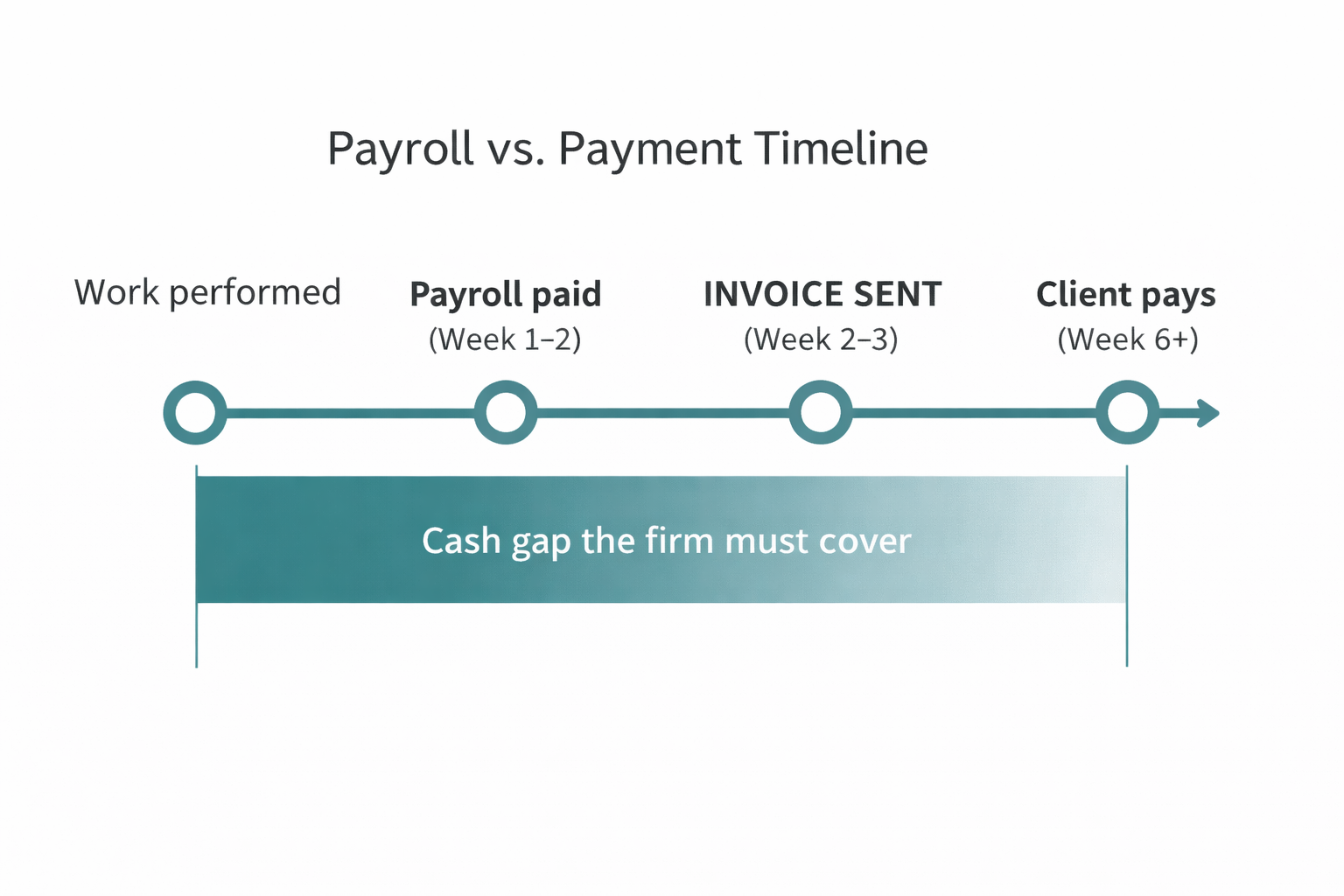
Most staffing firms pay weekly or biweekly. Meanwhile, most clients pay on net-15, net-30, net-45, or worse.
Even if the client is honest and pays exactly on time, your cash still arrives weeks after you have already paid wages, taxes, and workers’ comp.
Here is the basic timeline:
Work happens this week
Payroll goes out next week
Invoices go out later (sometimes much later)
Cash arrives weeks after wages were paid
That timing mismatch is normal. The problem is that many firms do not manage it proactively, so it quietly turns into stress.
Why growth makes cash pressure worse
This is the part owners often miss: growth amplifies the gap.
When you add placements or increase hours, your payroll outflow grows immediately. But the cash inflow from those placements does not show up until the invoicing and payment cycle completes.
So even if your gross margin stays the same, you can feel tighter on cash simply because you are carrying a larger receivable balance while payroll keeps hitting every week.
In other words: the better you do, the more working capital you need. If you do not build systems around that reality, growth becomes fragile.
The “phantom profit” trap
This is where many staffing owners get confused.
Your P&L can show a profit while your bank account is shrinking. That happens when accounts receivable is rising. You are “earning” revenue on paper, but you have not collected the cash yet, and payroll is draining cash ahead of it.
That is why staffing firms can look fine financially and still feel like they are constantly behind. The issue is not always profitability. Often, it is timing.
What causes billing to slow down (and makes the gap worse)
Most firms do not have a billing problem, they have a process problem. Billing is delayed by predictable operational bottlenecks, like:
Timecards approved late (or not at all)
Missing hours and manual corrections
Rate disputes that stall invoicing
Manual invoicing and inconsistent billing cycles
Waiting to “bundle” invoices instead of sending them on time
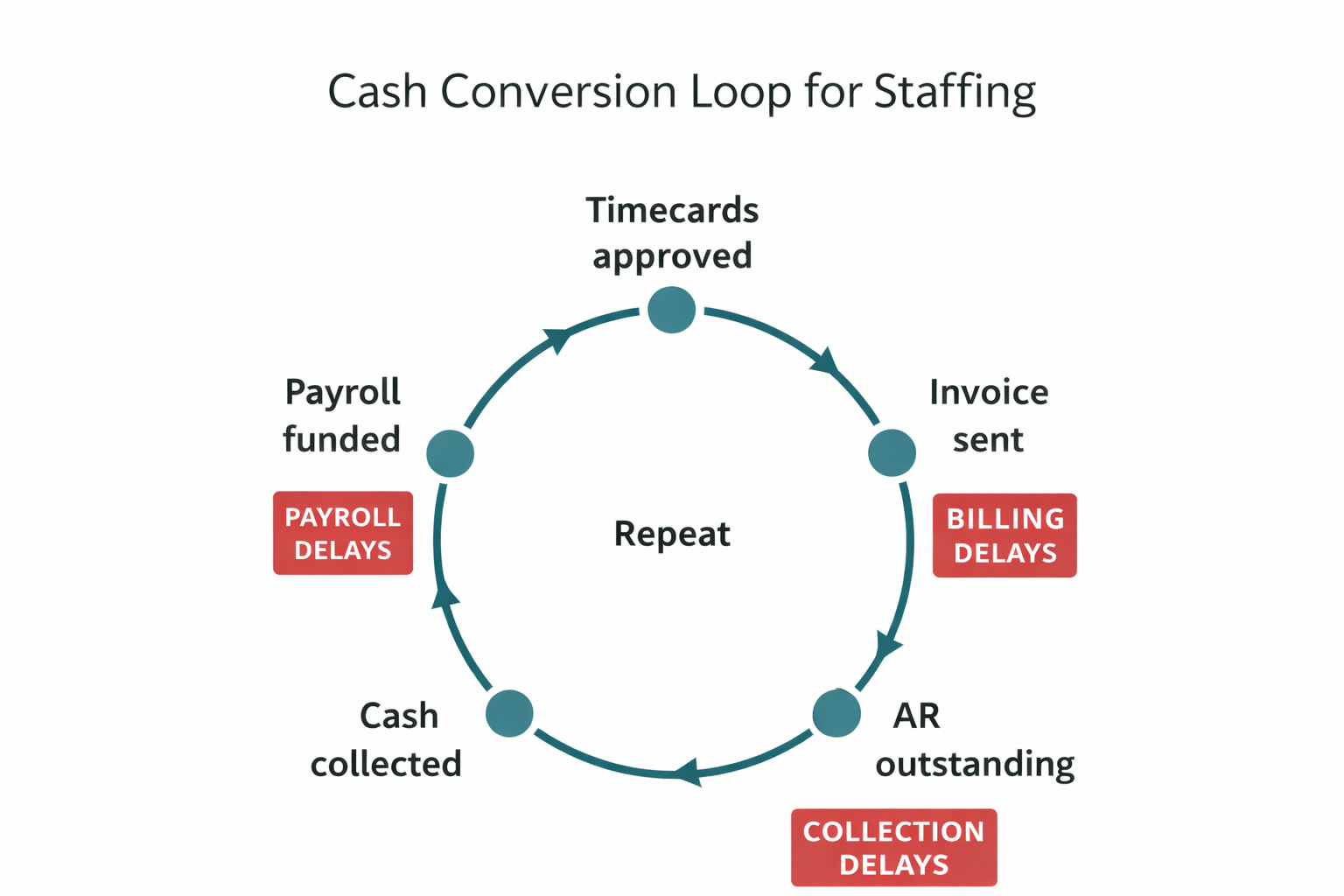
Each delay pushes invoices out, which pushes cash collection out, which increases the gap you are funding with your own cash.
So how do you fix it?
You do not need a complex finance strategy. You need to pull two levers consistently.
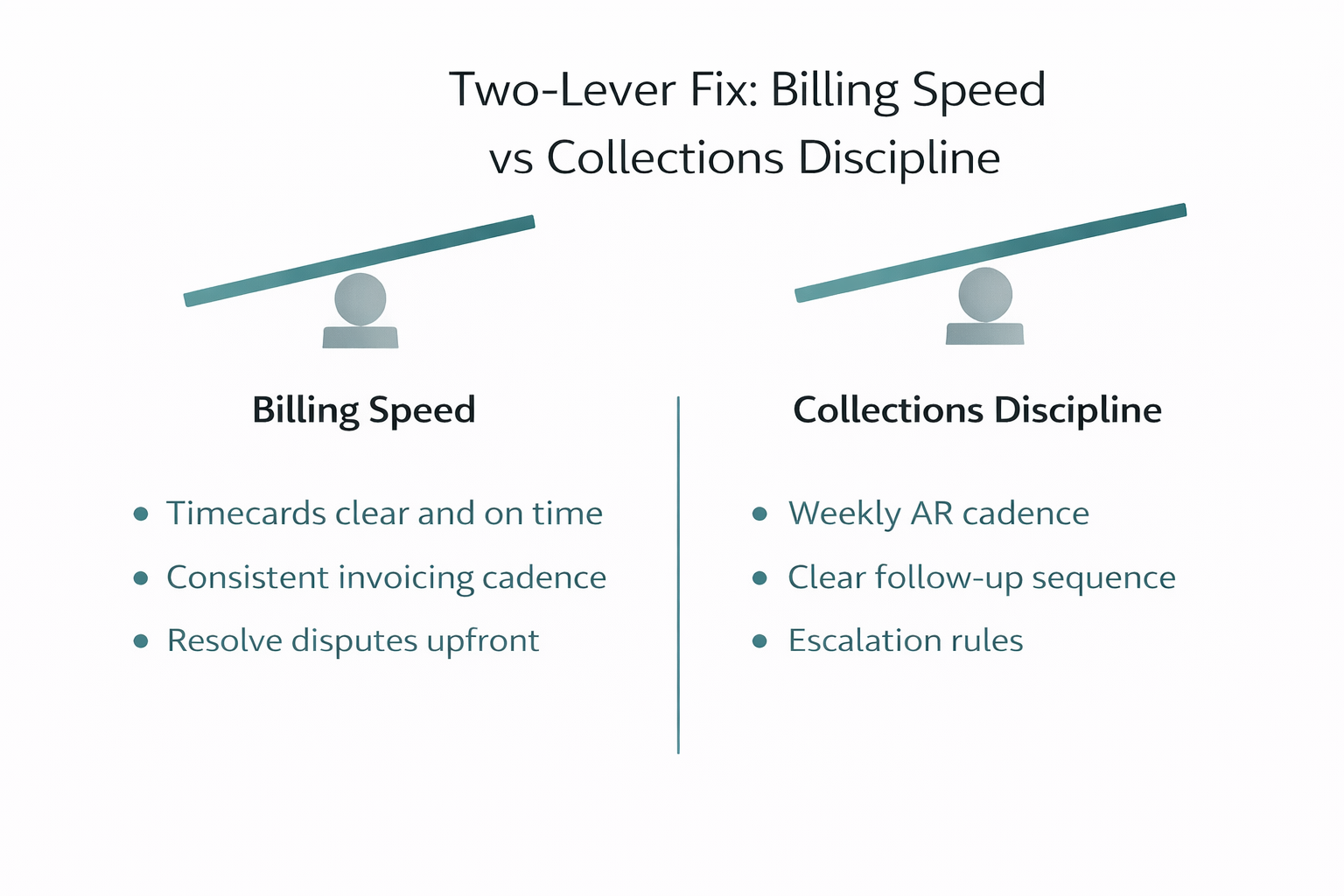
Lever #1: Billing speed (make invoices go out faster)
Billing speed is the first lever because it is the most controllable.
A few practical ways to tighten billing speed:
Set a hard timecard deadline (and enforce it)
Automate timecard reminders and approvals
Invoice on a consistent schedule (daily or weekly, not “when we get to it”)
Reduce exceptions that delay invoicing (missing approvals, unclear rates, sloppy documentation)
Clean up rate sheets and client terms so disputes are rare
The goal is simple: shorten the time between “work performed” and “invoice sent.” Every day you shave off that cycle reduces the amount of cash you need to float payroll.
Lever #2: Collections discipline (make cash come in faster)
Even if billing is fast, collections can still wreck you if it is passive.
Collections discipline means you treat AR like an operating system, not an occasional task when cash feels low.
What that looks like in practice:
Set payment terms clearly and upfront
Send invoices the same day each billing cycle (predictability helps clients pay)
Run a weekly AR cadence (every week, not “when someone remembers”)
Use a simple follow-up sequence for past due invoices
Escalate consistently, without drama, once an invoice crosses a threshold
Collections does not have to be aggressive. It has to be consistent. Most late payments happen because there is no system, not because clients are malicious.
Policies that protect you when clients pay slowly
Some clients will always pay slowly. For those, you need guardrails.
Common protections include:
Deposits or retainers for new clients
Stricter terms for slow payers (shorter terms, partial prepay, or milestone billing)
Credit limits based on client history
Pausing service when AR crosses a defined threshold
If you do not create boundaries, your firm becomes the bank. And banks do not operate on hope.
What to track weekly so you see the gap before it becomes a crisis
If you want to stay ahead of the staffing cash flow gap, track a short list of metrics weekly:
AR aging (current, 30, 60, 90+)
DSO (days sales outstanding)
Payroll-to-billing lag (how long invoicing trails payroll)
Cash on hand (weeks of payroll coverage)
A simple 13-week cash forecast
They’re not “finance” metrics. They’re the basics that keep a staffing firm stable.
Final Thought
Running tight on cash does not mean your staffing firm is failing. It often means the business has outgrown the systems managing it.
If profit looks fine but cash feels stressful, the answer is usually not more revenue. It is tightening billing speed and collections discipline so your cash catches up to your growth.
In our free Accounting Review, we help staffing firm owners pinpoint where the cash flow gap is coming from, and what to fix first so payroll stops feeling like a weekly fire drill.