
Eliminating Revenue Leakage in Staffing Firms: Systems and Processes to Capture Every Billable Hour
Revenue leakage rarely shows up as one obvious problem.
It usually happens in small places.
A few unapproved hours. A missed timesheet. A billing rate that does not match the contract. Overtime that gets paid but not fully billed. A placement that starts before the client paperwork is finalized.
Each issue may feel small on its own. But across dozens of employees, multiple clients, and weekly payroll cycles, those small gaps can quietly drain margin.
This article explains where revenue leakage happens in staffing firms, why it is so easy to miss, and what systems and processes help capture every billable hour.
What Revenue Leakage Means in a Staffing Firm
Revenue leakage is revenue your firm earned or should have billed, but did not fully capture.
In staffing, leakage often happens between:
Time worked
Time approved
Time paid
Time billed
Time collected
The work happened. The cost was incurred. Payroll may have already gone out.
But the client invoice does not fully reflect the revenue tied to that work.
That is what makes revenue leakage so damaging. It is not just lost revenue. It is often lost gross margin on labor you already paid for.
Why Staffing Firms Are Especially Vulnerable to Leakage
Staffing firms have more moving parts than many service businesses.
A typical week may include:
New starts
Terminations
Timesheet approvals
Client-specific billing rules
Overtime calculations
Shift differentials
Expense reimbursements
Payroll deadlines
Invoice deadlines
Rate changes
Contract updates
When these pieces are not tightly connected, leakage becomes easy.
The firm may be growing. Recruiters may be filling jobs. Clients may be happy. But if the back-office process does not capture every billable hour accurately, the financial results will not reflect the operational effort.
Growth can actually make leakage worse because more volume creates more chances for small errors to repeat.
Common Sources of Revenue Leakage
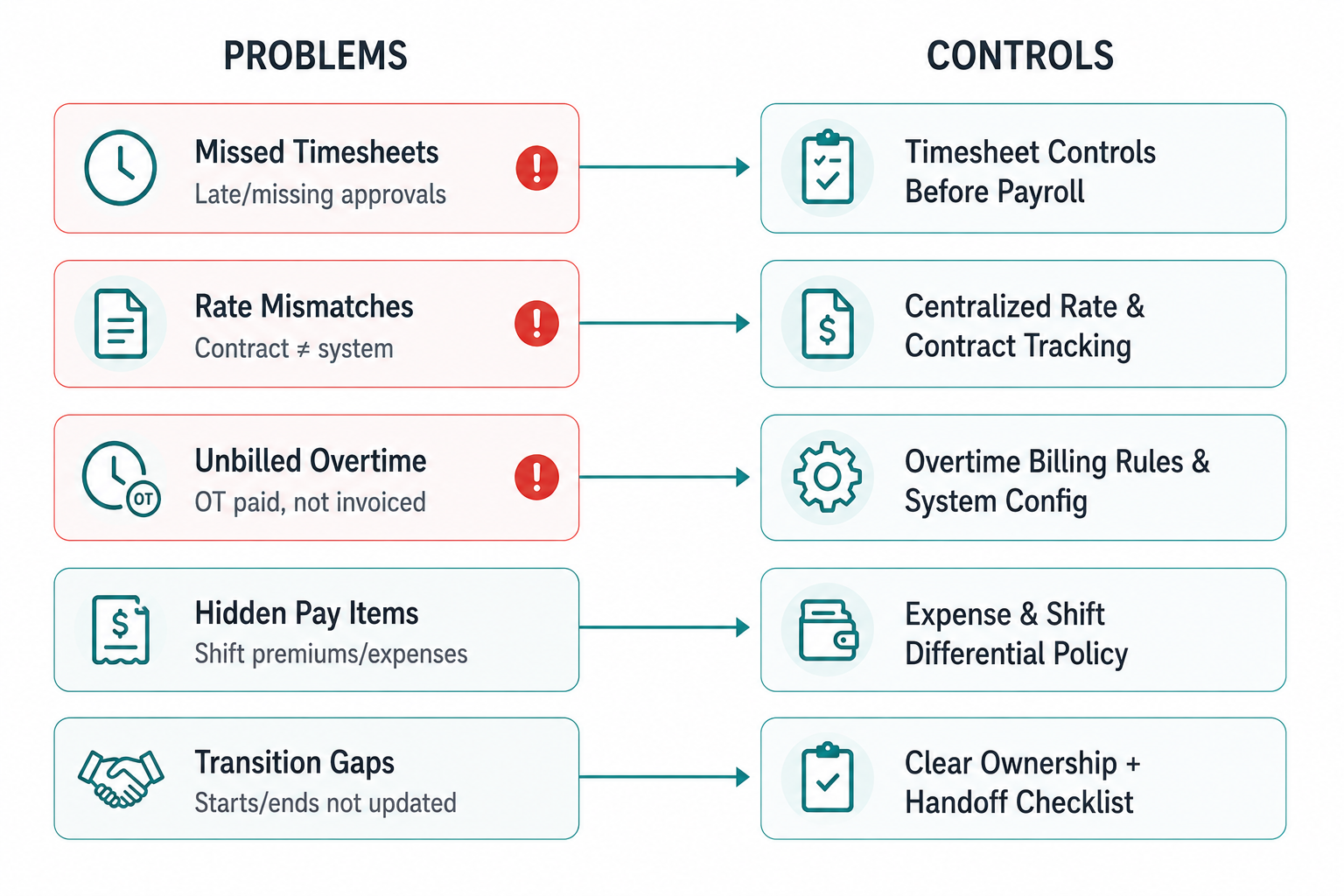
Most revenue leakage comes from process gaps, not one person making a major mistake.
Here are some of the most common places it appears.
Missed or Late Timesheets
Timesheets are the starting point for revenue capture.
When timesheets are missing, late, incomplete, or manually corrected after payroll, billing becomes harder to control.
Common problems include:
Hours paid before client approval
Manual timesheet adjustments
Late submissions after invoices are already sent
Different hour totals between payroll and billing
No clear follow-up process for missing approvals
If payroll is processed before all time is properly approved and reconciled, the firm may pay labor costs before knowing whether all hours will be billed.
That creates both margin leakage and cash flow risk.
Billing Rates That Do Not Match Agreements
A staffing firm may negotiate one rate, enter another rate into the system, and invoice a third rate months later.
This often happens when:
Client agreements are updated but billing systems are not
Pay rates change without corresponding bill rate changes
Recruiters negotiate exceptions outside the standard process
Rates are tracked in spreadsheets instead of a central system
Temporary discounts never expire
The issue is not always obvious because invoices still go out and clients still pay them.
But if the billed rate is too low, the firm loses margin every single week until the error is caught.
Overtime That Gets Paid but Not Fully Billed
Overtime is one of the most common leakage points in staffing.
The employee may be legally owed overtime. Payroll processes it correctly. But the client invoice may not fully capture the overtime billing rate.
This can happen when:
Overtime billing rules are unclear
Client contracts do not match payroll rules
The billing system is not configured correctly
Manual overrides are required
Recruiters or account managers approve overtime without checking billing terms
Overtime leakage is especially painful because the labor cost increases immediately. If the billing side does not increase with it, gross margin compresses fast.
Shift Differentials, Bonuses, and Expenses
Not all billable items are simple hourly wages.
Many staffing firms also deal with:
Shift premiums
Holiday rates
Per diems
Travel reimbursements
Credentialing fees
Background check fees
Client-approved bonuses
Mileage or parking reimbursements
Some of these items may be reimbursable. Some may be marked up. Some may not be billable at all.
The danger is inconsistency.
If the firm pays or absorbs these costs without a clear billing rule, margin becomes unpredictable.
Starts, Ends, and Role Changes Not Communicated Clearly
Revenue leakage often happens during transitions.
For example:
A candidate starts before the client setup is complete
A contractor changes roles but the bill rate is not updated
An assignment extension is approved informally
A worker ends but the system is not updated
A client changes the work schedule without back-office notification
These operational details affect billing.
If the back office receives the information late, invoices may be wrong, delayed, or incomplete.
The issue is usually not effort. It is handoff design.
Why Average Margin Hides Revenue Leakage
Revenue leakage is hard to see when management only looks at total gross margin.
The firm may see:
Revenue growing
Gross margin percentage holding steady
Clients paying invoices
Payroll being funded
But average margin can hide specific problems.
One client may be leaking overtime revenue. Another may have incorrect bill rates. Another may consistently submit late timesheets. Another may require extra admin work that is not visible in the numbers.
The total result may look acceptable while specific accounts are quietly underperforming.
That is why leakage needs to be reviewed at the client, role, and assignment level.
Warning Signs Your Staffing Firm Has Revenue Leakage
Revenue leakage usually shows up indirectly before it becomes obvious.
Common warning signs include:
Payroll reports do not tie cleanly to billing reports
Invoices require frequent manual corrections
Clients regularly dispute hours or rates
Gross margin varies unexpectedly by week
Recruiters negotiate terms that accounting finds out about later
Overtime hurts margin more than expected
Revenue grows but cash does not improve
The team relies heavily on spreadsheets to reconcile payroll and billing
If these feel familiar, the firm may not have a sales problem or a recruiting problem.
It may have a revenue capture problem.
The Systems Needed to Capture Every Billable Hour
Revenue leakage is reduced by building a process where time, payroll, billing, and accounting connect cleanly.
The goal is not more complexity.
The goal is fewer gaps.
Centralized Rate and Contract Tracking
Every client, role, and assignment should have a clear billing setup.
At a minimum, the firm should track:
Client bill rate
Employee pay rate
Standard markup or margin
Overtime billing rules
Holiday billing rules
Shift differentials
Reimbursable expenses
Start date
End date or assignment status
Approval requirements
This information should not live only in email threads or recruiter notes.
If billing depends on the information, it needs to be visible to the people responsible for invoicing and financial review.
Timesheet Controls Before Payroll
A strong staffing process includes a weekly review before payroll is finalized.
The review should answer:
Are all timesheets submitted?
Are all hours approved?
Do hours look reasonable compared to the assignment schedule?
Are there overtime hours?
Are there missing clients, roles, or workers?
Are any manual edits documented?
This step protects both payroll accuracy and billing accuracy.
Without it, the firm may pay wages first and discover billing problems later.
Payroll-to-Billing Reconciliation
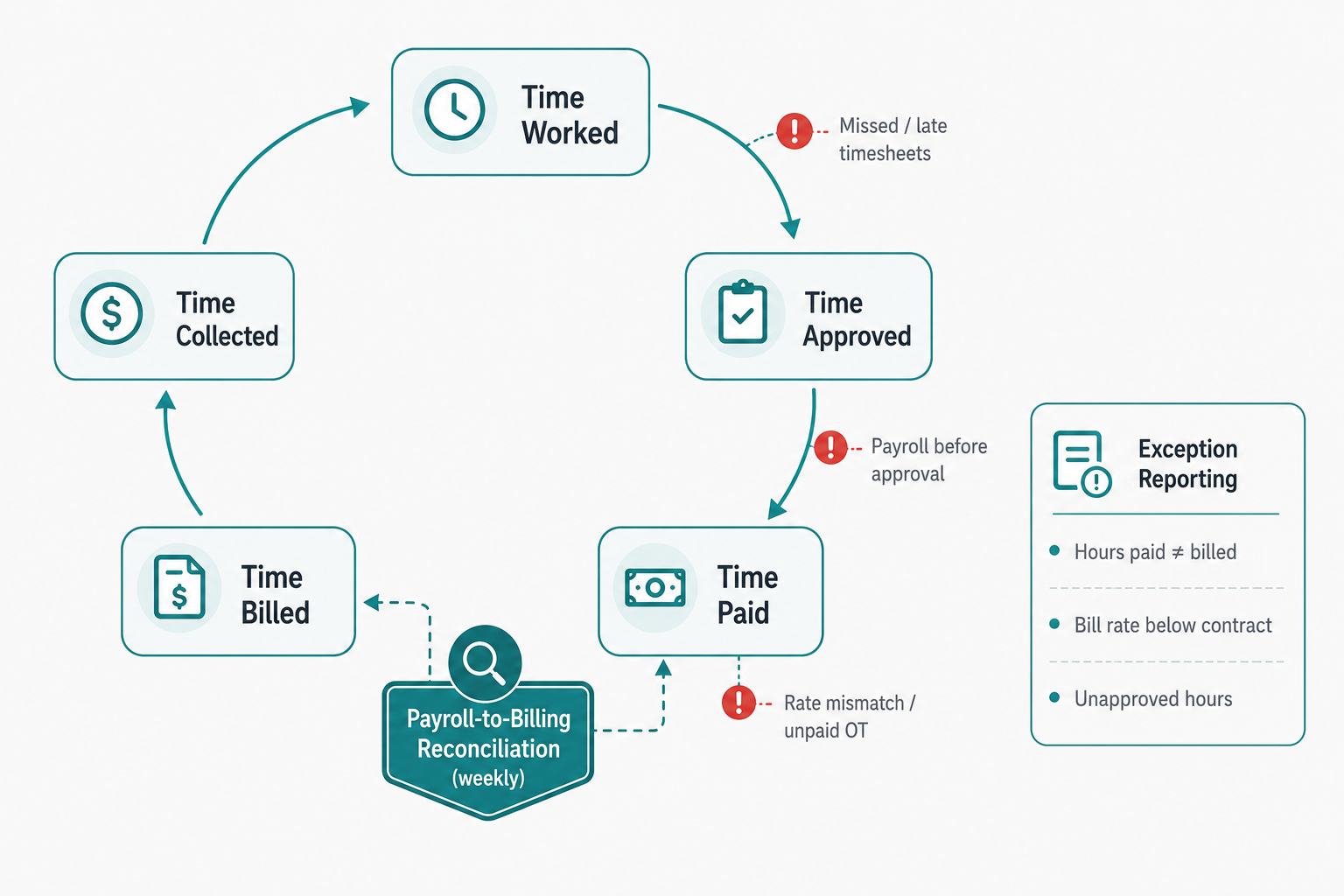
This is one of the most important controls for staffing firms.
After payroll and billing are processed, the firm should reconcile paid hours to billed hours.
The basic question is simple:
For every hour we paid, did we bill the client correctly?
The review should compare:
Employee hours paid
Client hours billed
Pay rate
Bill rate
Overtime hours
Non-billable hours
Adjustments
Reimbursements
This does not need to be overly complicated, but it does need to be consistent.
A weekly payroll-to-billing reconciliation helps catch leakage while it is still fixable.
Client-Level Margin Reporting
Revenue leakage becomes easier to spot when margin is reviewed by client.
Client-level reporting should show:
Revenue by client
Direct labor cost by client
Gross margin dollars
Gross margin percentage
Overtime impact
Adjustments or write-offs
Average collection timing
This helps owners see which clients are truly profitable and which ones are creating hidden drag.
A client with high revenue but constant billing issues may be less valuable than it appears.
Exception Reporting
Not every transaction needs the same level of review.
A good system highlights exceptions.
Examples include:
Hours paid but not billed
Bill rates below expected markup
Overtime paid without overtime billing
Unapproved timesheets included in payroll
Negative margin placements
Manual invoice adjustments
Clients with repeated disputes
Assignments without current rate documentation
Exception reporting helps the team focus attention where leakage is most likely.
Without exception reporting, staff spend too much time reviewing everything or miss the most important issues.
Clear Ownership Between Recruiting, Operations, and Accounting
Revenue leakage often happens when no one owns the full handoff.
Recruiters know the deal. Operations manages the assignment. Payroll pays the worker. Billing invoices the client. Accounting reviews the financials.
If each team only owns its piece, gaps appear between them.
A better process defines who is responsible for:
Entering new assignment details
Confirming rates
Updating contract changes
Approving overtime
Resolving missing timesheets
Reviewing billing exceptions
Communicating client disputes
Approving write-offs or credits
The process does not need to be bureaucratic.
But it does need clear ownership.
What to Review Before Trying to Increase Sales
Many staffing firms try to fix margin pressure by adding more revenue.
That can help, but not if the existing revenue capture process is leaking.
Before pushing for more sales, owners should understand:
Are all billable hours being invoiced?
Are rates accurate in the system?
Is overtime billed correctly?
Are client-level margins reliable?
Are billing adjustments tracked?
Are payroll and billing reports reconciled weekly?
More revenue flowing through a leaky process may create more work without creating more profit.
Fixing leakage first makes growth more valuable.
Final Thought
Revenue leakage is rarely dramatic.
It is quiet, repetitive, and easy to overlook.
But in staffing, small weekly misses can become meaningful margin loss because payroll costs are real and immediate. Every hour paid but not properly billed weakens the business.
Capturing every billable hour requires more than working harder. It requires clean systems, clear handoffs, and regular reconciliation between time, payroll, billing, and financial reporting.
In our Accounting Review, we help staffing firm owners identify where revenue leakage may be happening and how to build reporting that shows whether every billable hour is being captured.