
Reduce Time-to-Fill to Boost Margins: Metrics, Processes, and Tech for Staffing Firms
Time-to-fill is usually treated as a recruiting metric.
But for staffing firms, it is also a margin metric.
The longer a role stays open, the more internal time it consumes, the more recruiter capacity gets tied up, and the more revenue is delayed or lost. Even when the placement eventually happens, slow fulfillment can quietly weaken profitability.
This article explains why time-to-fill matters for staffing firm margins, which metrics to track, and how better processes and technology can improve both speed and financial performance.
What Time-to-Fill Means in a Staffing Firm
Time-to-fill measures how long it takes to fill an open job order.
At a basic level, it is:
Date the job order is opened to date the role is filled
For staffing firms, time-to-fill matters because open jobs represent potential revenue that has not yet started.
A temporary staffing role that takes too long to fill delays billable hours.
A direct hire role that takes too long to fill delays placement fees.
A high-priority client role that takes too long to fill may damage the relationship or cause the client to use another firm.
Time-to-fill is not just about recruiting speed. It affects revenue timing, recruiter productivity, client satisfaction, and margin.
Why Time-to-Fill Affects Margins
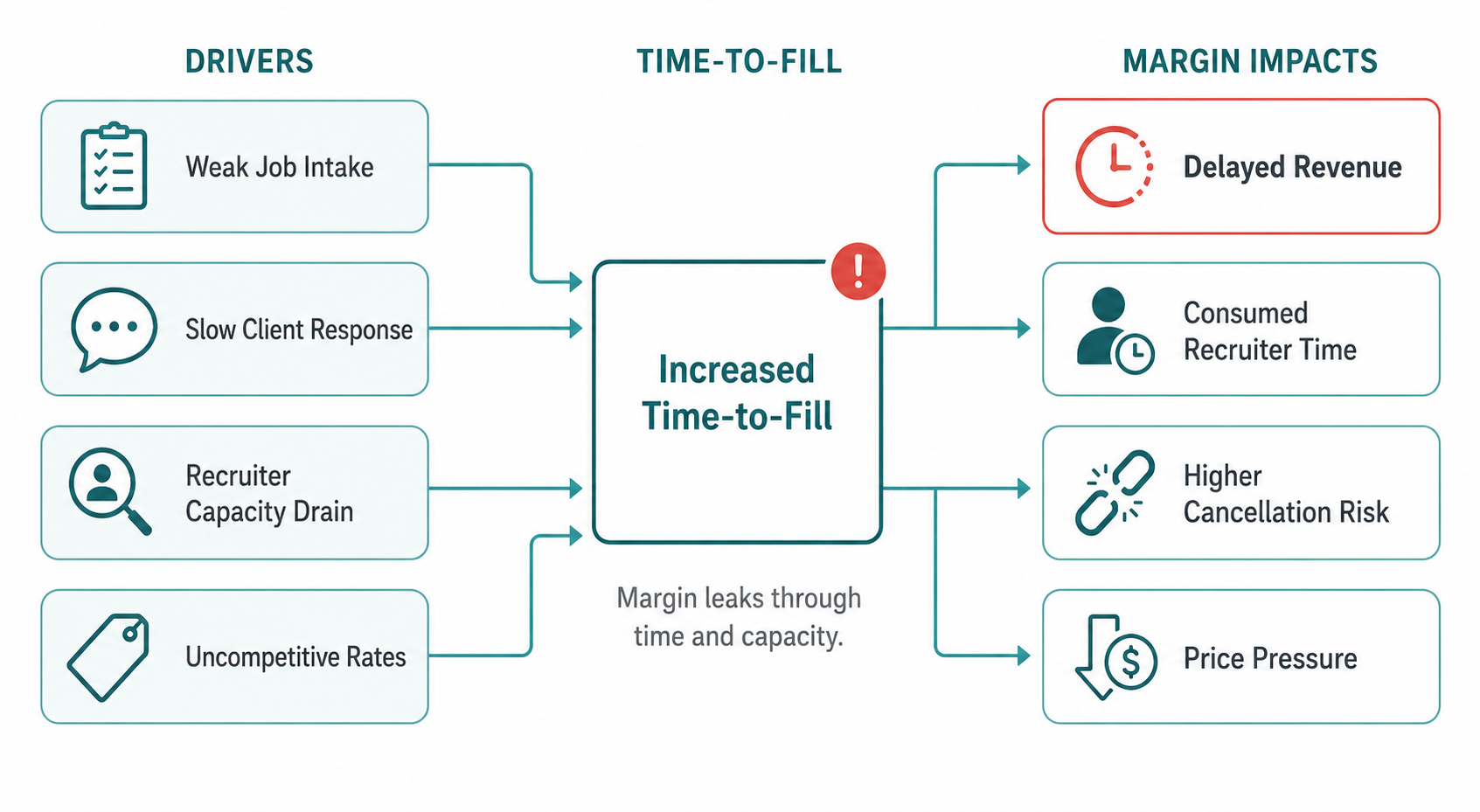
Margins are not only shaped by bill rates, pay rates, and fees.
They are also shaped by how efficiently the firm converts open opportunities into revenue.
When time-to-fill is high, firms often experience:
Lower recruiter output
More time spent on unfilled roles
Delayed revenue recognition
More client follow-up and administrative work
Higher risk of cancelled job orders
More pressure to discount or rush candidates through
A role can look profitable on paper but still consume too much internal capacity before it produces revenue.
That is where time-to-fill becomes a financial issue, not just an operational one.
The Hidden Cost of Slow Fulfillment
Slow fulfillment creates several margin leaks.
1. Recruiter Time Gets Consumed Without Revenue
Every open role requires activity:
Sourcing
Screening
Follow-up
Client communication
Candidate coordination
Job board management
Internal updates
If the role does not fill quickly, the firm absorbs those costs before earning anything.
For direct hire firms, this is especially important because recruiter time is often the largest delivery cost.
For temporary staffing firms, slow fulfillment delays the start of billable hours and can increase the likelihood that the client finds another solution.
2. Job Orders Lose Value Over Time
Not every open role remains valuable forever.
Some orders become stale. Some clients change priorities. Some hiring managers lose urgency. Some positions get filled internally or by a competitor.
A job order that looked strong on day one may not be worth the same effort by day 30.
Without visibility into aging job orders, firms may keep investing recruiting time into roles that are unlikely to convert.
3. Faster Placements Improve Revenue Timing
A faster fill does not just create revenue sooner.
It can also improve cash flow.
For temporary staffing, faster starts mean billable hours begin sooner. That helps revenue build earlier, even though payroll and collections still need to be managed carefully.
For direct hire, faster placements can shorten the gap between business development effort and fee collection.
Time-to-fill does not replace margin analysis, but it affects how quickly margin turns into revenue.
Key Time-to-Fill Metrics Staffing Firms Should Track
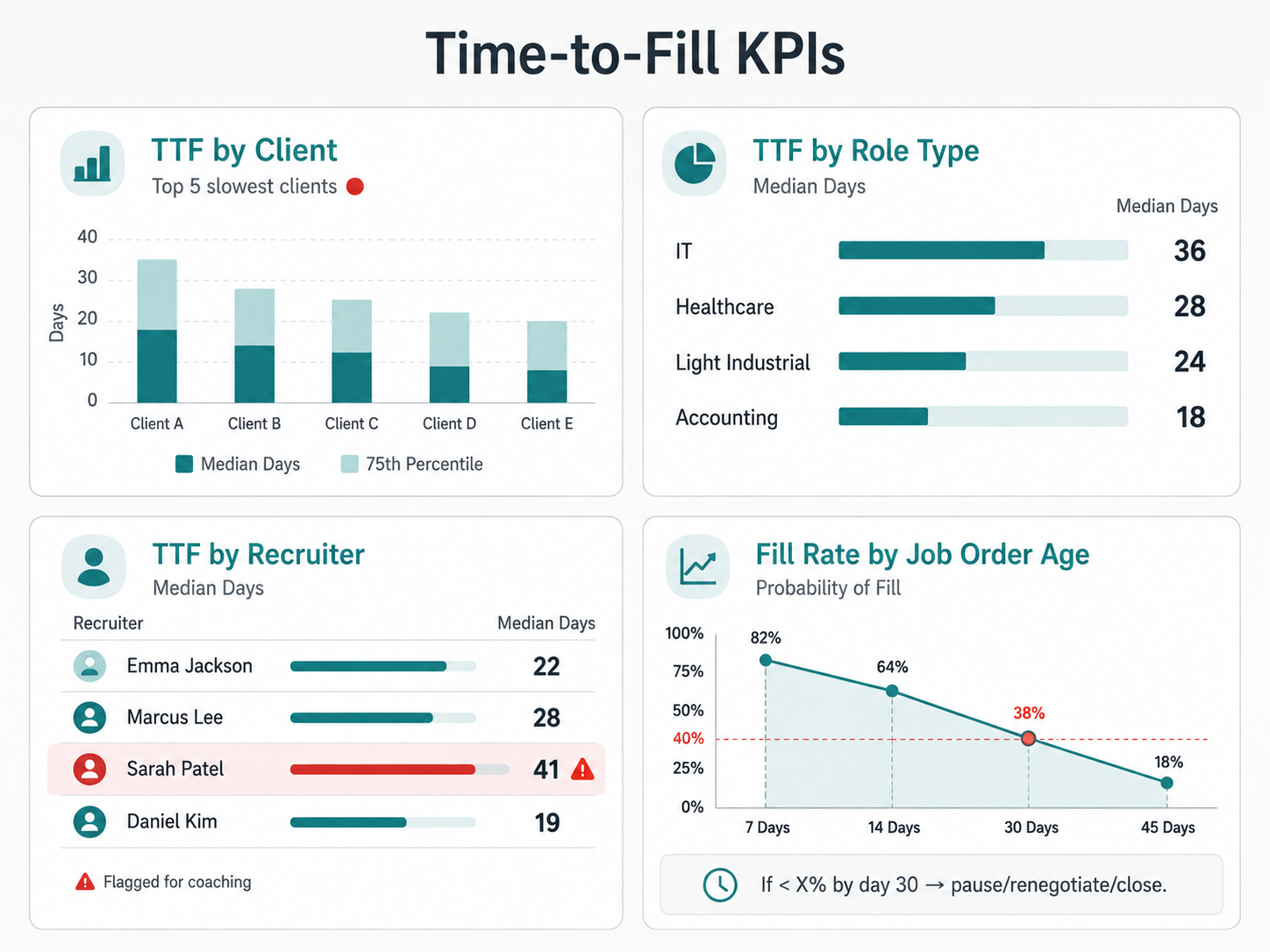
Tracking average time-to-fill is useful, but it is not enough.
Averages can hide the roles, clients, or recruiters that are creating the biggest delays.
Better visibility usually comes from tracking time-to-fill by segment.
Time-to-Fill by Client
Some clients are harder to fill for than others.
The issue may be:
Low bill rates
Slow feedback
Unclear job requirements
Poor candidate experience
Unrealistic expectations
Consistent late-stage changes
A client may look profitable based on gross margin but still drain recruiter capacity because roles take too long to fill.
Client-level time-to-fill helps owners see which clients create the most operational drag.
Time-to-Fill by Role Type
Different roles should not be judged by the same standard.
A light industrial role, healthcare role, accounting role, IT role, and executive search assignment will all have different fulfillment realities.
Role-level tracking helps identify whether slow fills are caused by market conditions, pricing issues, sourcing gaps, or process problems.
Time-to-Fill by Recruiter
Recruiter productivity is not only about number of placements.
It is also about how efficiently recruiters move qualified candidates through the process.
Tracking time-to-fill by recruiter can highlight:
Training needs
Process differences
Sourcing effectiveness
Client assignment issues
Workload imbalances
This should not be used as a simple blame metric. It should be used to understand where the process is working and where support is needed.
Fill Rate by Job Order Age
This is one of the most useful metrics.
It answers the question:
How likely are we to fill a job after it has been open for 7, 14, 30, or 45 days?
If fill probability drops sharply after a certain point, the firm can adjust priorities earlier.
That prevents recruiters from spending too much time on stale orders with low conversion odds.
Process Improvements That Reduce Time-to-Fill
Technology helps, but process usually comes first.
A staffing firm can have strong software and still struggle if job intake, client communication, and internal accountability are weak.
Improve Job Intake
Many time-to-fill problems start before sourcing begins.
A weak job order creates delays later.
A better intake process should clarify:
Required skills
Nice-to-have skills
Pay range or bill rate
Start date
Schedule
Location or remote expectations
Interview process
Client decision timeline
Reason the role is open
What makes a candidate successful
The goal is not to collect more information for its own sake. The goal is to prevent recruiters from working on unclear or unrealistic roles.
Set Client Response Expectations
Slow client feedback is one of the biggest causes of delayed fills.
If a client takes several days to respond to resumes, interview feedback, or rate questions, the best candidates may disappear.
Staffing firms should set clear expectations around:
Resume review time
Interview scheduling
Feedback deadlines
Offer decisions
Rate adjustments when needed
Clients who want fast fills need to participate in a fast process.
Prioritize Job Orders by Quality
Not all job orders deserve equal attention.
A strong job order may have:
Clear requirements
Competitive pricing
Responsive hiring manager
High urgency
Good fill history
Reasonable candidate availability
A weak job order may have the opposite.
Firms should avoid treating every open job as equally valuable. Job order prioritization protects recruiter capacity and improves margin.
Review Aging Orders Weekly
Aging job orders should be reviewed regularly.
For each older order, ask:
Is the client still serious?
Are the requirements realistic?
Is the rate competitive?
Have we submitted qualified candidates?
Is feedback timely?
Should we keep working this role?
This prevents open orders from sitting in the system without a clear decision.
Sometimes the right move is not to keep pushing. The right move is to renegotiate, pause, or close the order.
How Technology Can Help Reduce Time-to-Fill
Technology should support the process, not replace it.
The right tools can help staffing firms move faster, especially when they improve visibility and reduce manual work.
Useful technology areas include:
ATS reporting
Automated candidate matching
Resume parsing
Candidate communication tools
Job board integrations
Client portals
Pipeline dashboards
AI-assisted sourcing
Text and email automation
But the most important question is not whether the firm has technology.
The better question is:
Does the technology help the team make faster, better decisions?
A dashboard that shows aging job orders, candidate stage, client response time, and recruiter activity can be more valuable than a complicated tool that nobody uses consistently.
Warning Signs Time-to-Fill Is Hurting Margins
Time-to-fill problems often show up indirectly.
Common warning signs include:
Recruiters are busy but placements are flat
Revenue feels inconsistent despite many open jobs
Clients complain about speed
Job orders stay open too long without clear next steps
Recruiters spend too much time on low-quality roles
Gross margin looks fine, but internal capacity feels stretched
Direct hire fees are unpredictable
Temporary staffing revenue starts slower than expected
If these feel familiar, the issue may not be effort. It may be process visibility.
Why Faster Is Not Always Better
Reducing time-to-fill does not mean rushing poor candidates into roles.
A bad placement can create replacement costs, client dissatisfaction, reputation damage, and extra internal work.
The goal is not speed at any cost.
The goal is efficient, disciplined fulfillment.
A healthy time-to-fill process should balance:
Speed
Candidate quality
Client responsiveness
Pricing discipline
Recruiter capacity
Gross margin
Fast placements only help margins when they are also good placements.
What to Look at Before Making Changes
Before investing in new software or pushing recruiters to move faster, staffing firm owners should understand:
Time-to-fill by client
Time-to-fill by role type
Time-to-fill by recruiter
Fill rate by job order age
Client response time
Gross margin by client and role
Revenue lost or delayed from unfilled orders
Without this visibility, it is hard to know whether the problem is sourcing, pricing, client behavior, recruiter workflow, or job order quality.
The solution depends on the cause.
Final Thought
Time-to-fill is more than a recruiting metric.
It is a signal of how efficiently a staffing firm turns opportunity into revenue.
When roles take too long to fill, margin pressure builds quietly through wasted recruiter time, delayed revenue, stale job orders, and weaker client relationships.
Improving time-to-fill is not about forcing recruiters to work harder. It is about building a clearer process, tracking the right metrics, and using technology to remove friction.
In our Accounting Review, we help staffing firm owners connect operational metrics like time-to-fill with financial results, so they can see where revenue, margin, and cash flow are being created or lost.