
Why Your Gross Margin Looks Fine but Net Income Stalls
A staffing firm can show a healthy gross margin and still feel like the business is barely moving forward.
Revenue is up. Placements are active. Gross margin looks acceptable. But net income does not improve the way it should.
This is frustrating because gross margin is often the first number owners look at when judging financial health. And in staffing, it is an important number. But it is not the whole story.
This article explains why your gross margin can look fine while net income stalls, what causes the gap, and where staffing firm owners should look before assuming the business just needs more revenue.
Gross Margin Is Only the First Layer
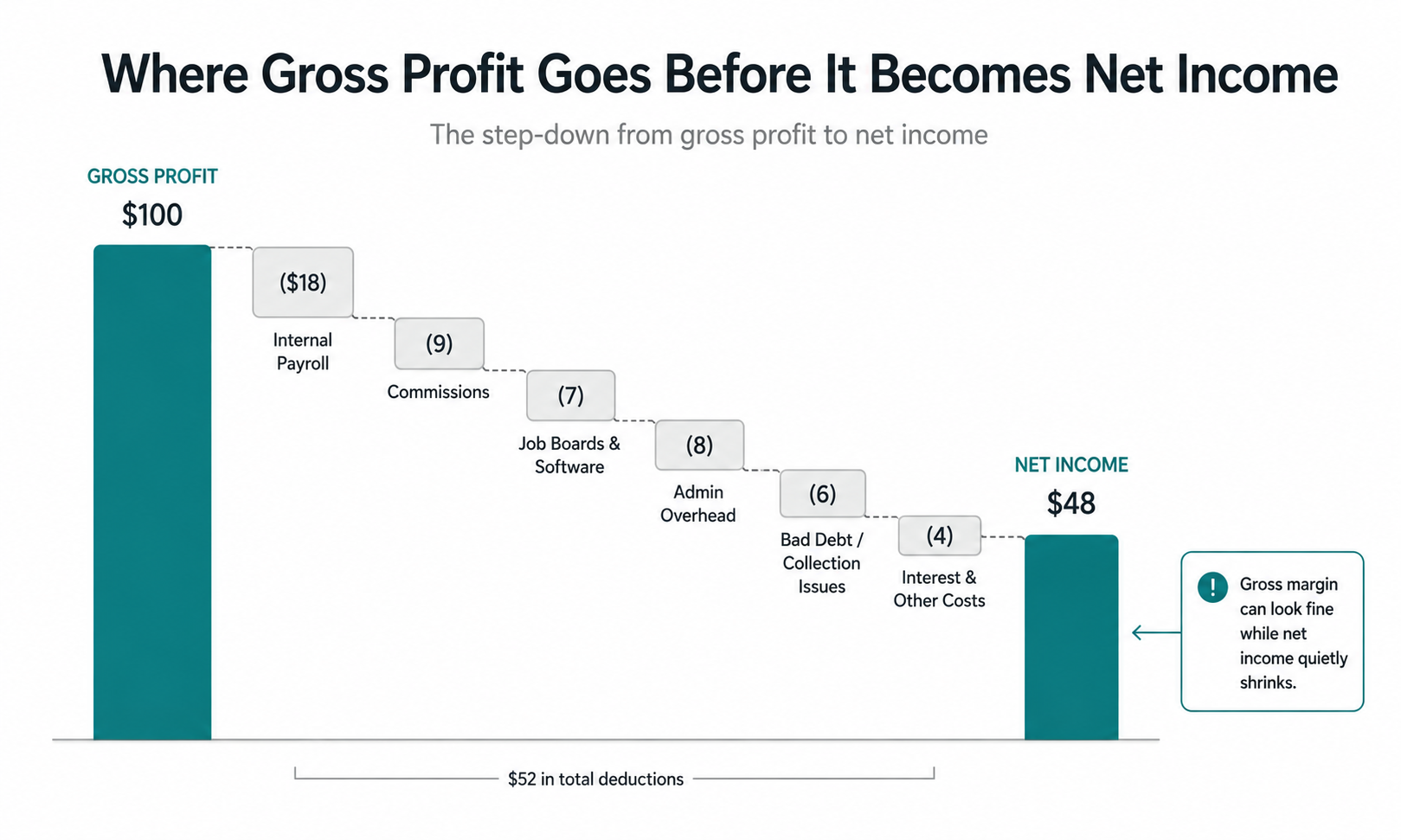
Gross margin tells you what is left after direct delivery costs.
For staffing firms, this usually means:
Revenue minus direct labor costs
Direct labor costs may include:
W2 wages paid to placed employees
Employer payroll taxes
Workers’ compensation
Benefits tied directly to placed employees
Other delivery costs connected to the assignment
Gross margin answers an important question:
How much money is left after delivering the staffing service?
But net income answers a different question:
How much money is left after running the whole business?
That second question includes everything gross margin does not.
What Gross Margin Does Not Include
A staffing firm can have a strong spread between bill rates and pay rates but still lose profitability below the gross margin line.
Gross margin usually does not include:
Internal recruiter salaries
Sales team compensation
Commissions
Job board costs
Software subscriptions
Insurance
Office and admin expenses
Owner salary
Management overhead
Bad debt
Professional fees
Interest expense
These costs can quietly grow underneath gross margin.
That is why a firm with a 28% gross margin may be more profitable than a firm with a 35% gross margin, depending on how efficiently the rest of the business operates.
Why Net Income Stalls Even When Gross Margin Looks Fine
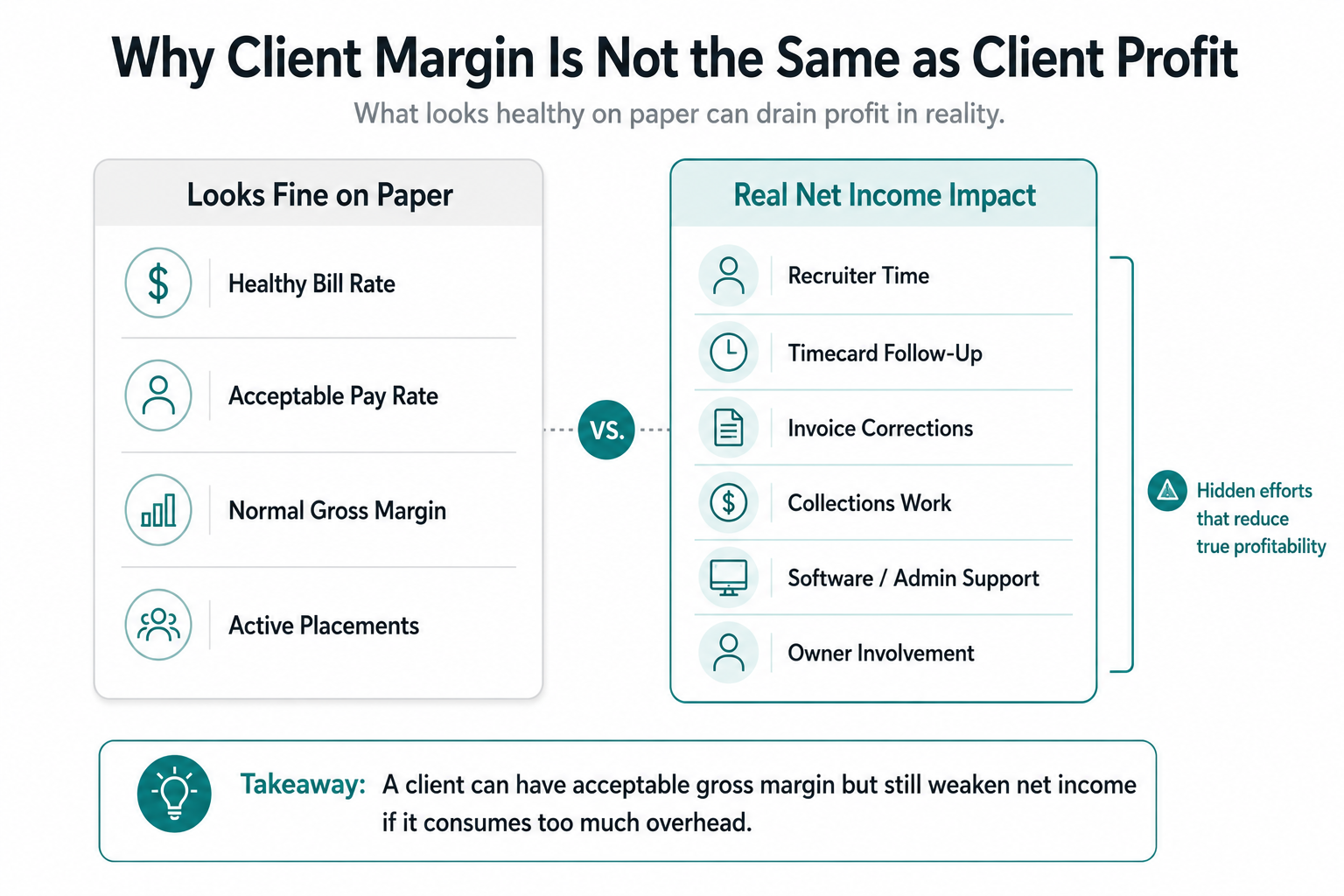
When net income does not improve, the issue is usually not one single line item.
It is usually a combination of small leaks that build up over time.
1. Overhead Grows Faster Than Gross Profit
This is one of the most common reasons net income stalls.
As revenue grows, staffing firms often add:
Recruiters
Salespeople
Admin support
Payroll support
Software
Management layers
Outside consultants
Some of these costs are necessary. Growth usually requires infrastructure.
The problem is when overhead grows before the revenue base can support it.
A staffing firm may add $20,000 of monthly gross profit but also add $18,000 of monthly overhead. Gross margin still looks fine, but almost none of the improvement reaches the bottom line.
Revenue grows, but profit does not.
2. Recruiter Productivity Is Too Low
In staffing, internal labor is often one of the biggest costs below gross margin.
If recruiter compensation rises but recruiter output does not rise with it, net income gets squeezed.
This can happen when:
Recruiters manage too few active roles
Fill rates are inconsistent
Too much time is spent on low-value clients
Commission plans are not tied to profitable growth
Poor systems create unnecessary admin work
Gross margin may look healthy at the placement level, but the firm still needs enough gross profit per internal employee to support payroll.
If internal headcount expands faster than production, net income stalls.
3. Sales Commissions Eat More Than Expected
Commission plans can create hidden profitability issues.
A placement may look profitable based on gross margin, but once commissions are paid, the economics may be much weaker.
This is especially true when commissions are based on revenue instead of gross profit, or when the firm pays commissions before cash is collected.
Common issues include:
Commission paid on low-margin accounts
Commission paid before client payment
Commission structures that reward volume over profitability
No adjustment for slow-paying or high-maintenance clients
A deal can look good at the gross margin level but become mediocre after commissions and collection risk.
4. Job Boards and Recruiting Tools Keep Expanding
Software and recruiting tools are easy to justify individually.
One job board subscription here. One sourcing tool there. One CRM add-on. One automation tool. One reporting tool.
Each one may make sense on its own.
But together, they can create a meaningful monthly cost base that does not always scale with revenue.
The issue is not whether tools are useful. The issue is whether they are producing enough gross profit to justify their cost.
If software costs rise while net income stays flat, the firm may be buying efficiency without measuring whether that efficiency is actually showing up in profit.
5. Low-Margin Clients Consume Too Much Internal Time
Average gross margin can hide client-level problems.
Some clients may produce acceptable margin on paper but require excessive:
Recruiter attention
Timecard follow-up
Invoice corrections
Collections work
Credentialing
Admin support
Owner involvement
These clients may look profitable if you only review bill rate, pay rate, and burden.
But once you include the internal time required to service them, their real profitability may be weak.
This is one reason staffing firms can feel busy without becoming more profitable.
The team is working hard, but too much effort is going toward accounts that do not contribute enough to net income.
6. Pricing Does Not Reflect the Full Cost of Delivery
A staffing firm’s pricing floor should not only cover wages, payroll taxes, workers’ comp, and benefits.
It also needs to support the cost of running the business.
That includes:
Recruiting capacity
Sales effort
Back-office support
Technology
Management time
Collection risk
Profit for the owner
When pricing only protects gross margin, the firm may win work that looks acceptable at the placement level but does not support the company as a whole.
This is how firms grow revenue while net income stays flat.
The work is profitable enough to look good, but not profitable enough to build a healthier business.
Warning Signs Your Net Income Problem Is Below Gross Margin
Net income issues often show up before owners can clearly identify the cause.
Common warning signs include:
Revenue is growing, but profit is flat
Gross margin looks acceptable, but cash still feels tight
The team is busier, but owner income is not improving
Software and internal payroll keep creeping up
Some clients feel exhausting despite looking profitable
You are unsure which clients actually support the business
These signs usually mean the issue is not just gross margin.
The issue is what happens after gross margin.
Why More Revenue May Not Fix It
The natural reaction is to think the firm needs more sales.
Sometimes that is true.
But if the business has a weak cost structure, more revenue can simply create more activity without improving profit.
More revenue can also bring:
More payroll exposure
More recruiter workload
More admin complexity
More client follow-up
More software needs
More management stress
Growth only improves net income when each new dollar of revenue contributes enough gross profit after delivery and overhead.
Otherwise, the firm just becomes larger and more complicated.
Not necessarily more profitable.
What to Review Before Making Big Changes
Before cutting costs, raising prices, or pushing for more sales, staffing firm owners should understand a few key numbers.
Start with:
Gross margin by client
Gross margin by role or placement type
Gross profit per internal employee
Sales commissions as a percentage of gross profit
Software and job board costs as a percentage of gross profit
Admin time required by client
Net income trend compared to revenue growth
The goal is not just to find expenses to cut.
The goal is to understand which parts of the business actually convert revenue into profit.
That clarity helps owners make better decisions about pricing, hiring, client selection, and growth.
Final Thought
A good gross margin does not automatically create a healthy staffing firm.
Gross margin tells you whether the work is priced above direct delivery cost. Net income tells you whether the entire business model is working.
When gross margin looks fine but net income stalls, the issue is usually hidden below the gross margin line: overhead, internal payroll, commissions, software, admin burden, and low-quality client mix.
The answer is not always to sell more.
Sometimes the answer is to understand where gross profit is leaking before it reaches the bottom line.
In our Accounting Review, we help staffing firm owners see what happens after gross margin, so they can identify which clients, costs, and operating habits are helping or hurting net income.