
Pricing Floors for Staffing Firms: The Minimum Spread You Need to Stay Healthy
If you run a staffing firm, you have probably asked some version of this question:
How low can we price this and still make money?
That question matters. But it can also be dangerous.
Many staffing firms think about pricing in terms of winning the client. They look at the pay rate, add a markup, compare it to what competitors might charge, and decide whether the deal is worth taking.
But staffing pricing should not only be about winning business.
It should be about making sure each client supports a healthy, stable, and profitable firm.
This article explains what a pricing floor is, why minimum spread matters, and how staffing firms can avoid taking on clients that create revenue but weaken the business.
What a Pricing Floor Means in Staffing
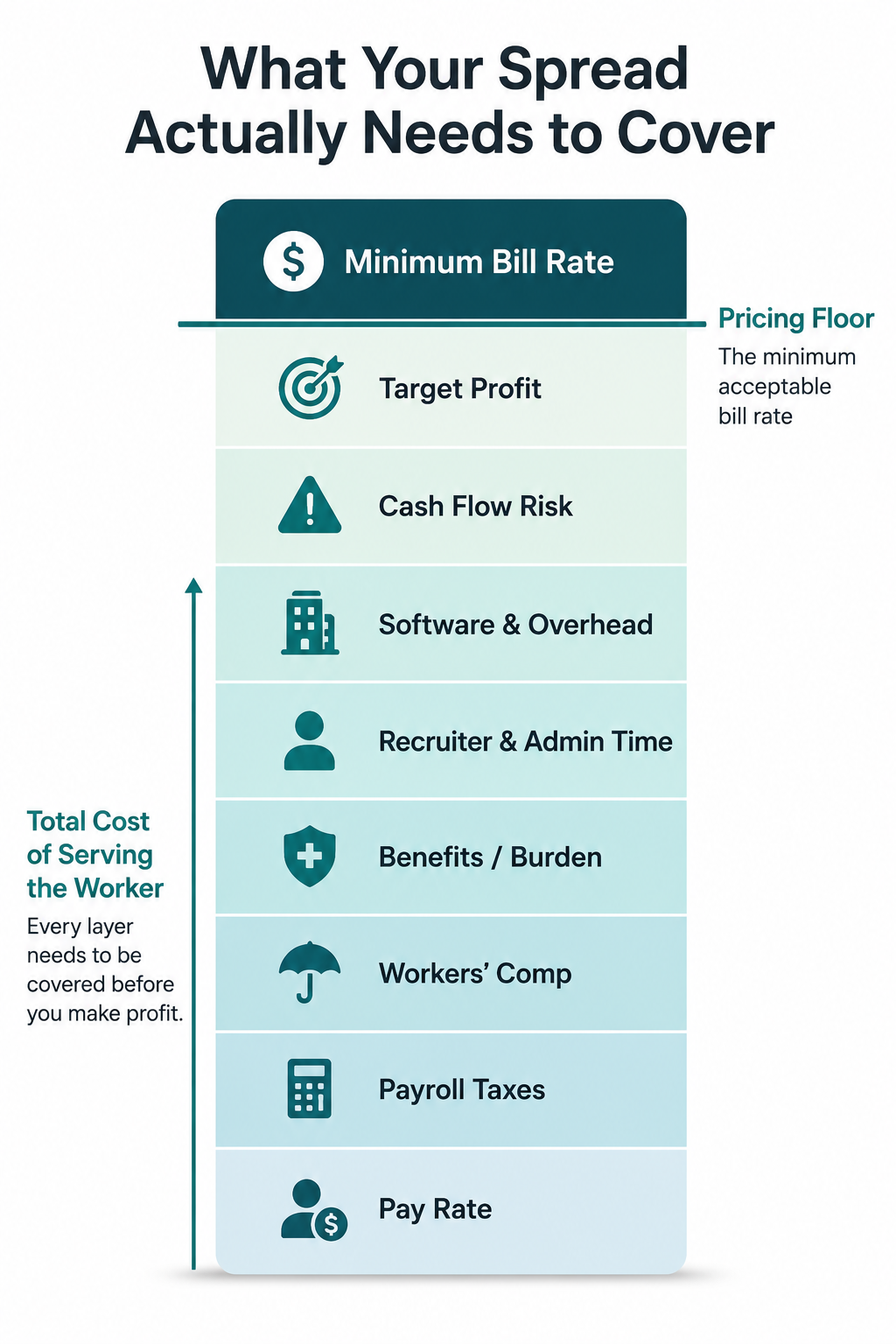
A pricing floor is the minimum bill rate or spread you need before a placement is worth accepting.
At a basic level, spread is:
Bill rate minus pay rate
For example:
Bill rate: $32/hour
Pay rate: $24/hour
Spread: $8/hour
That $8 spread is what the staffing firm has left to cover:
Payroll taxes
Workers’ comp
Benefits or burden costs
Recruiter and sales compensation
Software and admin costs
Bad debt risk
Cash flow timing
Profit
The problem is that many firms look only at the difference between bill rate and pay rate. But the real question is:
After all direct costs, overhead, risk, and cash flow pressure, is this client still worth it?
Why Minimum Spread Matters
A low spread can look acceptable at first, especially when the client offers steady volume.
But volume does not automatically fix weak pricing.
If the spread is too thin, more placements can actually increase stress. The firm takes on more payroll, more receivables, more admin work, and more risk without creating enough margin to support the business.
Healthy pricing should do more than cover wages.
It should create enough room to:
Fund payroll before clients pay
Absorb slow collections
Pay internal staff
Cover operating costs
Create profit
Support growth
If the spread cannot do those things, the placement may be creating revenue without creating a healthy business.
Why Staffing Firms Accept Pricing Below the Floor
Pricing problems usually do not happen because owners ignore profit.
They happen because the pressure to win business is immediate, while the cost of weak pricing shows up later.
1. The Client Looks Strategic
A large client may feel worth discounting because of potential volume.
But if the rate structure is too thin, the client can become a drain instead of an opportunity.
More volume at bad pricing usually creates a bigger problem, not a better client.
2. Competitors Are Pricing Aggressively
Staffing can be competitive, especially when clients see candidates as interchangeable.
But matching a competitor’s low rate only works if your cost structure can support it.
Otherwise, you are copying their price without knowing whether their economics are healthy.
3. Wage Costs Rise Faster Than Bill Rates
Pay rates move quickly. Client pricing often moves slowly.
If your firm raises pay to fill roles but does not adjust bill rates, spread quietly shrinks over time.
That erosion may not be obvious until payroll pressure or margin problems appear.
4. Average Margin Hides Weak Clients
A firm may have a healthy overall gross margin while certain clients, roles, or locations are below the pricing floor.
The average looks fine.
The business still feels tight.
That usually means underpriced work is being hidden inside the total numbers.
The Minimum Spread Is Not the Same for Every Firm
There is no universal spread that works for every staffing firm.
Your pricing floor depends on factors like:
Industry niche
Pay rates
Workers’ comp exposure
Payroll tax burden
Benefits structure
Client payment terms
Recruiter compensation
Internal overhead
Expected profit margin
A $5/hour spread may be acceptable in one situation and completely unhealthy in another.
The point is not to use one fixed number forever.
The point is to know the minimum economics your firm needs before saying yes.
Warning Signs Your Pricing Floor Is Too Low
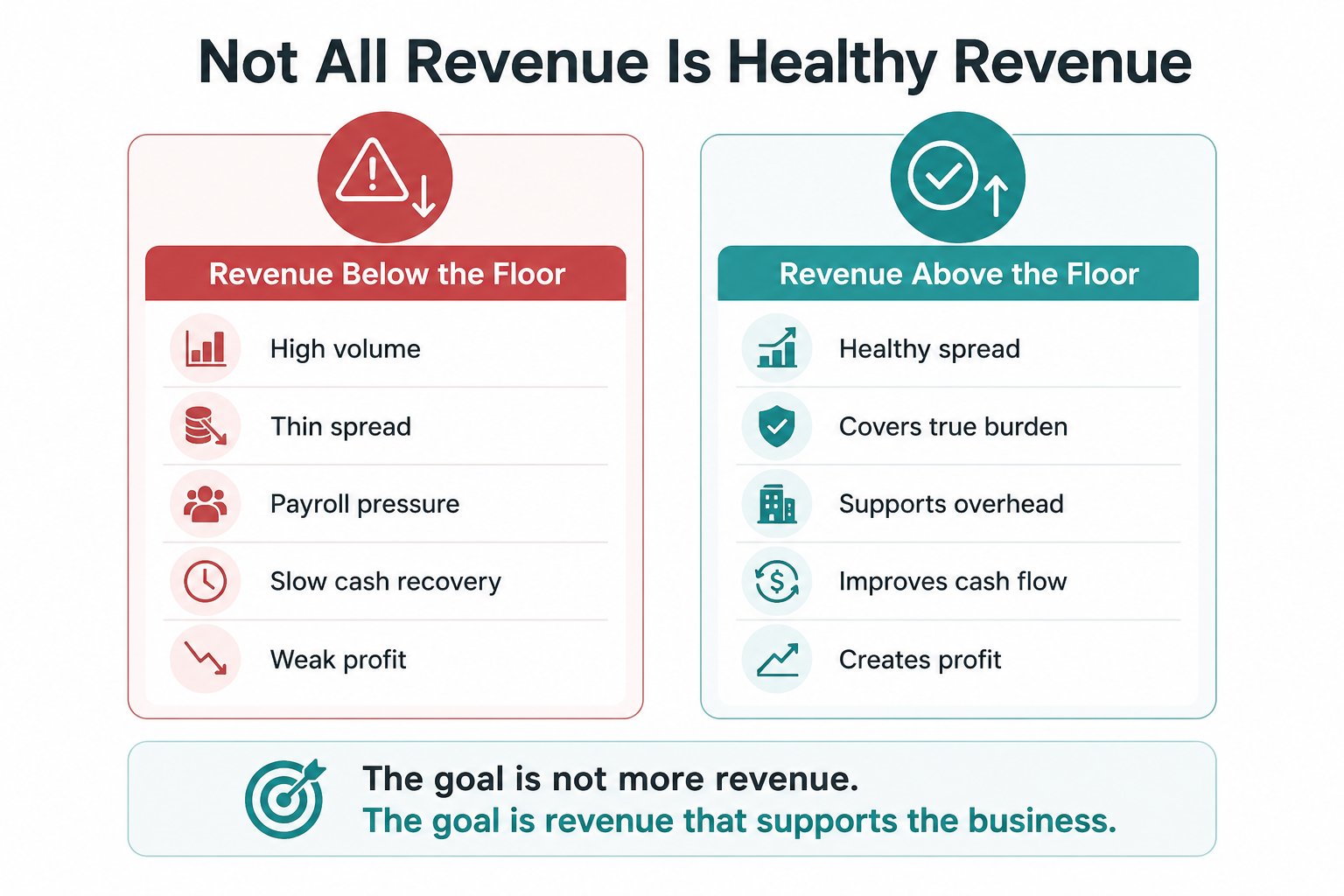
Pricing floor problems usually show up indirectly first.
Common warning signs include:
Revenue is growing, but cash is not improving
Payroll feels stressful despite steady placements
Certain clients require too much internal attention
Gross margin looks fine, but net profit is weak
You hesitate to hire because cash feels unpredictable
Large clients do not seem to produce meaningful profit
If these feel familiar, the issue may not be sales volume.
It may be pricing discipline.
What to Review Before Lowering Your Price
Before discounting to win or keep a client, staffing firm owners should understand:
Actual burden cost by role
Gross margin by client
Spread by role or placement type
Client payment history
Internal time required to support the account
Cash flow impact of the client’s payment terms
Without that visibility, lowering price is a guess.
Sometimes a discount is strategic. But it should be a decision, not a reaction.
How to Think About a Healthy Pricing Floor
A healthy pricing floor should answer three questions.
1. Does this spread cover the true cost of the placement?
This includes more than pay rate.
It should include payroll taxes, workers’ comp, benefits, insurance, and any other direct burden tied to the employee.
2. Does this client leave enough margin after overhead?
The placement may be profitable at the gross margin level but still weak after recruiter time, admin work, software, collections, and management attention.
3. Does the payment timing create too much cash pressure?
A low-spread client who pays slowly can be especially dangerous.
Thin margin plus slow collections means the firm is carrying payroll risk without enough reward.
Final Thought
A pricing floor is not about being rigid.
It is about protecting the health of the business.
Staffing firms do not struggle only because they lack revenue. Many struggle because too much revenue is priced too close to the floor.
The goal is not just to win clients. The goal is to win clients that support stable cash flow, healthy margins, and long-term growth.
In our Accounting Review, we help staffing firm owners identify which clients, roles, and placements are creating healthy profit, and which ones may be priced too close to the floor.