
Temp vs Direct Hire vs Perm: Which Service Line Really Drives Profit and Why
If your staffing or recruiting firm offers multiple service lines, you have probably asked this question:
Which part of the business is actually the most profitable?
Temporary staffing may drive the most revenue. Direct hire and perm placement may show the highest margins. But the best service line is not always the one with the highest revenue or the cleanest gross margin.
This article explains how each model creates profit differently, and what staffing firm owners should look at before deciding where to focus.
Revenue Does Not Tell the Whole Story
Revenue is easy to track, but it can be misleading.
A temporary staffing division may produce far more top-line revenue than direct hire, while creating less owner profit. That happens because each service line has a different cost structure, cash flow profile, and operational burden.
The better question is not:
Which service line generates the most revenue?
The better question is:
Which service line creates the most profit after risk, labor, time, and cash flow are considered?
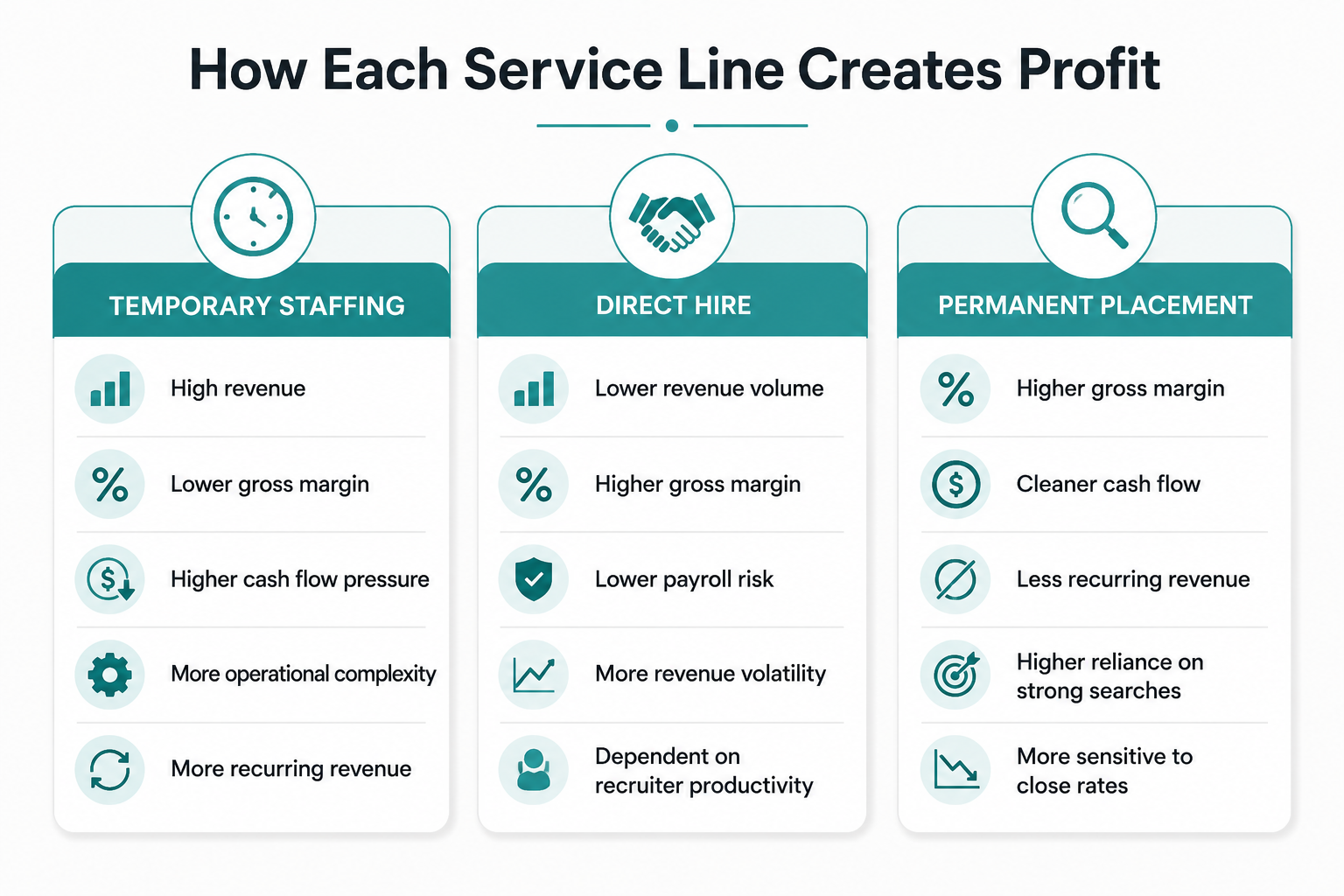
Temporary Staffing: High Revenue, Lower Margin, More Cash Pressure
Temporary staffing often creates the largest revenue because billings happen continuously as employees work hours for clients.
The model can be attractive because it creates recurring activity, ongoing client relationships, and more predictable weekly revenue.
But it also carries real financial pressure.
The firm usually pays employees weekly or biweekly, while clients may pay 30, 45, or even 60 days later. That creates a built-in cash gap.
Temp staffing also has direct costs tied to wages, payroll taxes, workers’ compensation, benefits, payroll processing, and compliance.
Because of this, temp staffing usually depends on:
Pay rate vs bill rate discipline
Accurate payroll burden
Client payment speed
Assignment volume
Timecard and billing accuracy
Temp staffing can be very profitable, but only when pricing, collections, and operations are managed closely.
Direct Hire and Perm Placement: Higher Margin, Less Predictable Revenue
Direct hire and permanent placement usually show much higher gross margins.
The firm earns a placement fee, often based on a percentage of the candidate’s first-year salary. There is no weekly payroll to fund, and there are fewer direct labor costs.
That creates a cleaner financial model.
But the tradeoff is volatility.
A few strong months can make the business look excellent. A slow quarter can quickly create pressure.
Direct hire and perm placement depend heavily on recruiter productivity, client urgency, candidate availability, fee discipline, close rates, and guarantee period risk.
These service lines may have higher margins, but they are not automatically better. A high-margin placement that takes months to close may be less valuable than a lower-margin temp account that produces steady weekly gross profit.
Why Gross Margin Alone Is Not Enough
It is easy to compare service lines by gross margin.
Temporary staffing might show a lower margin. Direct hire might show a much higher margin.
At first glance, direct hire looks better.
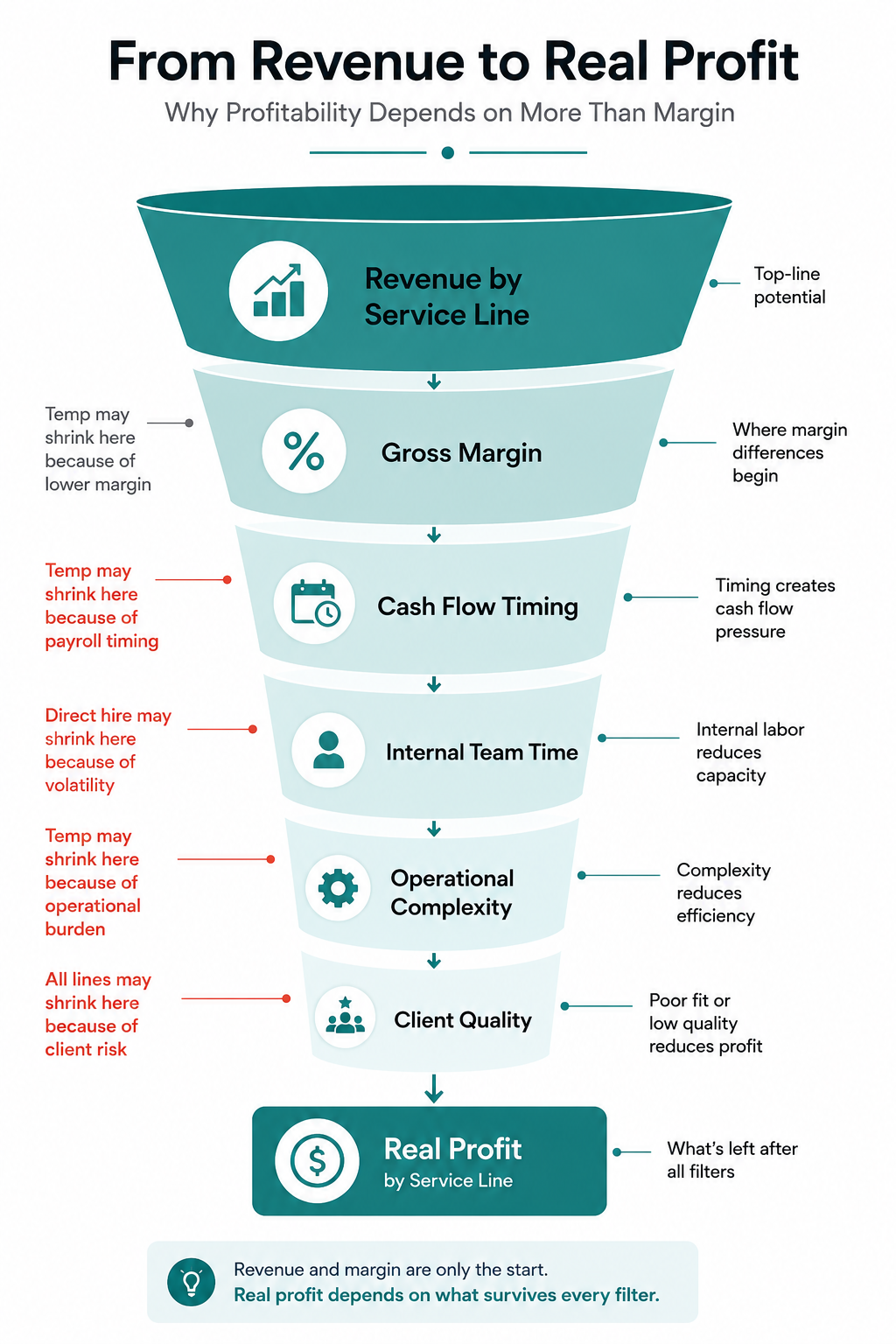
But gross margin does not show how much internal recruiter time was required, how long the sale took, whether the client paid quickly, how repeatable the revenue is, or how much operational work was needed.
The better comparison is contribution profit.
That means looking at what is left after direct costs and internal effort are considered.
Which Service Line Really Drives Profit?
There is no universal answer.
For some firms, temporary staffing drives profit because recurring gross profit is steady and scalable.
For others, direct hire drives profit because the margins are high and the team can place candidates efficiently.
For many firms, the best answer is the right mix.
The key is understanding how each service line performs after considering:
Gross margin
Cash flow timing
Internal labor
Client concentration
Revenue predictability
Operational complexity
Without this clarity, a firm may scale the service line that creates the most work, not the most profit.
Warning Signs You Need Better Service Line Clarity
Many staffing firm owners know total revenue and total profit, but not profit by service line.
Common warning signs include:
Revenue is growing, but cash feels tight
Direct hire feels profitable, but income is unpredictable
Temp staffing creates payroll stress
The team is busy, but owner profit is flat
Some clients require far more effort than others
You are not sure which service line deserves more focus
If any of these feel familiar, the issue may not be sales. It may be visibility.
Final Thought
The best service line is not always the one with the highest revenue or the highest gross margin.
The best service line is the one that creates the strongest combination of profit, predictability, cash flow, and operational fit.
In our Accounting Review, we help staffing firm owners break down profitability by service line, client, and placement type so they can see which parts of the business are really driving profit and which ones are quietly creating stress.