
Timecard Approval Lag: The Silent Margin Killer
If you run a staffing firm, you probably watch bill rates, pay rates, gross margin, and receivables.
But one margin problem often hides in plain sight:
Timecard approval lag.
On the surface, late timecards may seem like an operational annoyance. A client approves hours late. A manager forgets. A recruiter follows up. Payroll still has to be processed.
But in staffing, timecard delays can quietly hurt cash flow, distort margins, delay invoicing, and create avoidable stress around payroll.
This article explains why timecard approval lag matters, how it affects staffing firm profitability, and what owners should watch before it becomes a bigger issue.
Why Timecard Approval Lag Matters
Staffing firms operate on timing.
Employees are paid quickly. Clients pay later. Invoices need to go out accurately and on time.
When timecards are delayed, that rhythm breaks.
A late timecard can delay:
Client invoicing
Payroll review
Revenue recognition
Margin reporting
Collections follow-up
Cash flow forecasting
One late approval may not seem like much. But when delays happen repeatedly across multiple clients, they create a quiet financial drag.
The business may still be profitable on paper, but the cash flow and reporting feel messier than they should.
The Staffing Firm Timing Problem
In many staffing firms, payroll happens weekly or biweekly.
Clients may pay invoices in 30, 45, or even 60 days.
That means the firm is already funding payroll before collecting cash.
Timecard approval lag makes that timing gap worse.
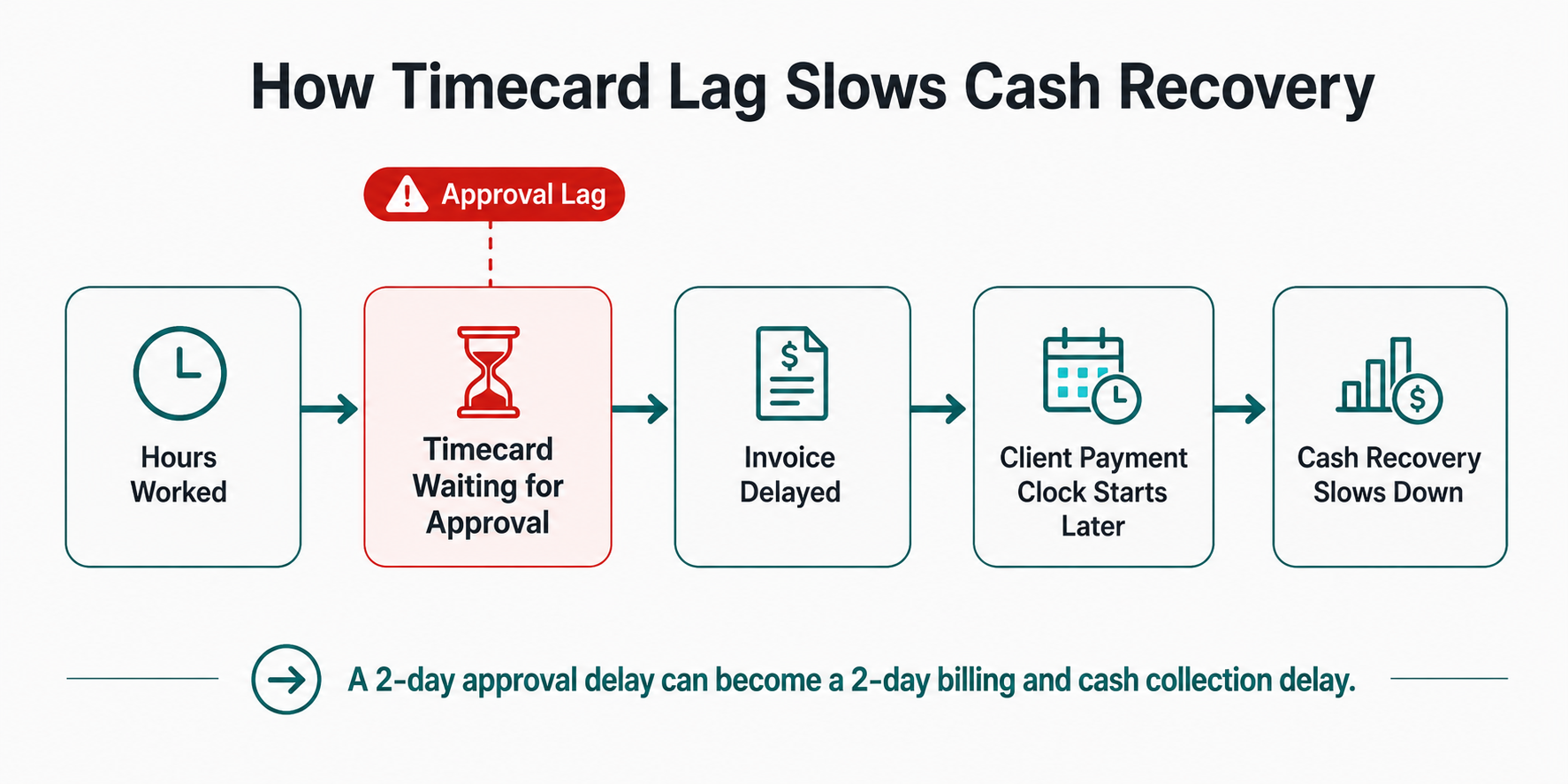
Instead of invoicing immediately after the work is completed, the firm waits for approval. Then the invoice goes out later. Then the client payment clock starts later.
A two-day delay in approval can easily become a two-day delay in invoicing, collections, and cash recovery.
And in staffing, small timing delays compound quickly.
How Timecard Lag Hurts Margin
Timecard delays do not always show up as obvious margin issues. That is why they are easy to ignore.
But they can affect margin in several ways.
1. Delayed Invoicing Pushes Cash Recovery Further Out
If hours are worked this week but approved late, invoicing may slip into the next billing cycle.
That means the firm still pays payroll, but waits longer to bill and collect.
The result is a wider cash gap.
Even if the placement is profitable, delayed invoicing increases the amount of working capital needed to support the same revenue.
This is especially painful when the client already pays slowly.
2. Manual Follow-Up Consumes Internal Time
Late approvals create extra work.
Someone has to chase the client. Someone has to check the timecard system. Someone has to verify whether payroll can be processed. Someone has to decide whether to pay based on expected hours or wait for formal approval.
That internal time is real cost.
It may not appear in direct labor costs, but it reduces profitability because recruiter, payroll, and admin time are pulled into avoidable follow-up.
A client with a decent gross margin may be less profitable than it looks if they require constant timecard chasing.
3. Payroll Risk Increases
When approvals are late, staffing firms often face an uncomfortable decision:
Pay the employee before client approval
Delay payroll processing
Estimate hours and clean it up later
Rush approvals at the last minute
None of these are ideal.
Paying before approval may protect the employee relationship, but it increases billing risk. Waiting may create payroll pressure. Estimating hours can create corrections, credits, or disputes later.
The cleaner the timecard process, the lower the payroll risk.
4. Billing Errors Become More Likely
Late approvals often create rushed invoicing.
Rushed invoicing creates errors.
Common issues include:
Missed hours
Incorrect overtime
Wrong billing rates
Unbilled expenses
Late adjustments
Duplicate corrections
These errors may seem small, but they directly affect margin.
A few missed hours or unbilled overtime items can quietly reduce profitability, especially on thin-spread staffing work.
5. Client-Level Profitability Gets Distorted
When timecards are delayed, financial reporting becomes less reliable.
Revenue may be recorded in a different period than the related payroll cost. Gross margin may look lower in one week and higher in another. Client profitability may appear uneven even when the underlying work is steady.
This makes it harder to answer basic questions like:
Which clients are actually profitable?
Which roles create cash strain?
Which accounts require too much admin time?
Which clients consistently delay billing?
Without clean timing, margin clarity gets harder.
Why Average Margin Can Hide the Problem
A staffing firm may look fine in total.
Overall gross margin may be acceptable. Revenue may be growing. Payroll may be getting processed.
But averages can hide client-specific issues.
One client may approve timecards quickly, pay on time, and require minimal follow-up.
Another client may have the same gross margin on paper but consistently approve hours late, delay invoicing, dispute invoices, and require repeated admin attention.
Those two clients are not equally healthy.
Timecard lag is one reason average gross margin can be misleading.
Warning Signs Timecard Approval Lag Is Hurting the Business
Timecard issues usually show up indirectly first.
Common warning signs include:
Invoices going out later than expected
Frequent last-minute payroll reviews
Payroll processed before full approval
Repeated client follow-ups for missing timecards
Billing adjustments after invoices are sent
Revenue growth without better cash flow
Client profitability that looks inconsistent month to month
Admin or payroll staff constantly chasing approvals
If these feel familiar, the issue is probably not just operational. It is financial.
What Staffing Firms Should Track
Before trying to fix the process, staffing firms should measure the problem.
Useful metrics include:
Average time from work performed to timecard approval
Average time from approval to invoice sent
Percentage of timecards approved late
Late approvals by client
Late approvals by manager or department
Billing adjustments tied to timecard issues
Payroll processed before client approval
Invoice delays caused by missing timecards
The goal is not to create a complicated dashboard.
The goal is to identify which clients, roles, or internal processes are creating the most drag.
How to Reduce Timecard Approval Lag
Once the issue is visible, improvement usually comes from tightening the process.
A few practical steps can help.
1. Set Clear Client Expectations Up Front
Timecard expectations should be part of the client relationship, not an afterthought.
Clients should know:
When timecards are due
Who approves them
What happens if approvals are late
How late approvals affect billing and payroll
Who should be contacted if the approver is unavailable
The best time to set this expectation is during onboarding, before the first payroll cycle.
2. Create a Weekly Approval Rhythm
Timecard approval should not depend on memory.
A simple weekly rhythm can help:
First reminder before the deadline
Second reminder on the due date
Escalation if approval is still missing
Internal review before payroll closes
The more predictable the process, the less manual chasing is needed.
3. Track Late Approvals by Client
Not all clients create the same problem.
Some clients may be consistently late. Others may only miss approvals occasionally.
Tracking late approvals by client helps the firm separate one-off issues from structural problems.
That matters because a consistently late client may need a different conversation, different billing terms, or different internal handling.
4. Connect Timecard Data to Margin Reviews
Timecard delays should not live only in operations.
They should be part of financial review.
If a client has thin margins, slow approvals, and slow payments, that client may be much less valuable than revenue suggests.
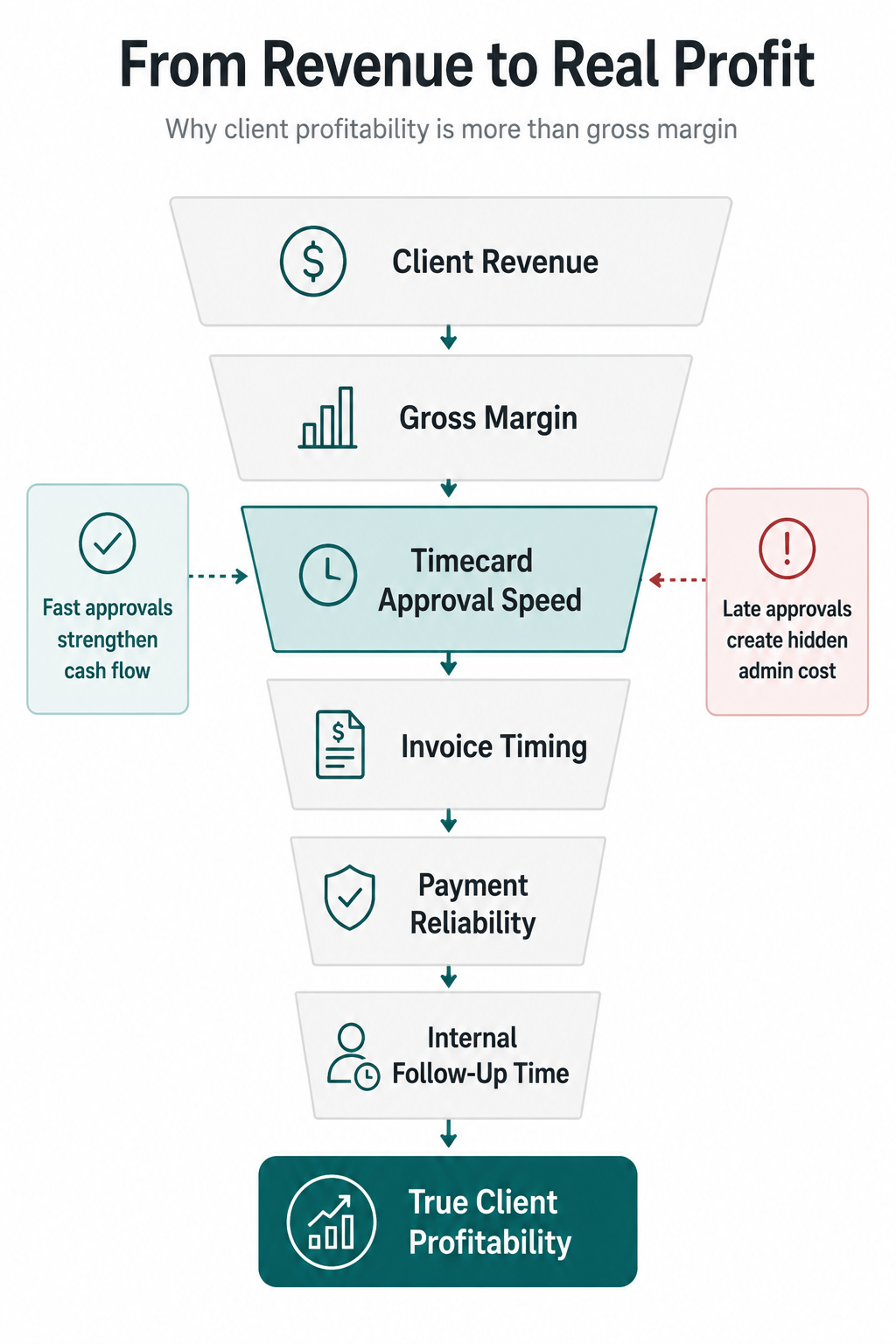
Client profitability should consider:
Gross margin
Payment timing
Timecard approval behavior
Billing disputes
Internal follow-up time
Payroll exposure
That gives the owner a clearer picture of which clients are actually helping the firm grow.
Why This Is a Margin Issue, Not Just an Admin Issue
It is easy to think of timecards as back-office paperwork.
But in staffing, timecards are tied directly to revenue, payroll, billing, and cash flow.
A slow approval process can create:
Delayed billing
Longer cash conversion cycles
More payroll exposure
Higher admin burden
More billing errors
Less reliable margin reporting
That is why timecard approval lag is a silent margin killer.
It does not always show up as one big obvious problem. It slowly weakens the financial rhythm of the business.
Final Thought
Timecard approval lag may not look like a major financial issue at first.
But in staffing, timing is margin.
The faster and cleaner the path from hours worked to approved timecard to invoice sent, the stronger the firm’s cash flow and reporting become.
If your numbers look fine but billing, payroll, and collections always feel harder than they should, timecard approval lag deserves a closer look.
In our Accounting Review, we help staffing firm owners identify where margin and cash flow are being lost, including approval delays, billing timing, and client-level profitability issues.