
When a “Profitable” Client Is Actually a Loss: A Staffing Client Profitability Checklist
Staffing firms do not usually lose money because the overall business model is broken. They lose money one client at a time.
A client can look “profitable” on the surface and still quietly drain cash and bandwidth underneath. The reason is simple: most staffing firms measure profit at the company level, but the real story lives at the client and assignment level.
This post walks through the most common hidden drivers that turn a “good” client into a bad one, and a practical checklist to spot the problem early.
Why client profitability is different in staffing
In staffing, profitability is not just revenue minus wages. It is gross profit after true delivery costs, measured by client, role, and assignment.
Two clients can generate the same revenue and have completely different economics because of:
pay rate volatility
overtime behavior
workers’ comp and burden differences
timecard and billing friction
dispute and write-off patterns
If you do not track these by client, you will miss the slow leaks until the account feels exhausting.
The hidden drivers that turn “profit” into a loss
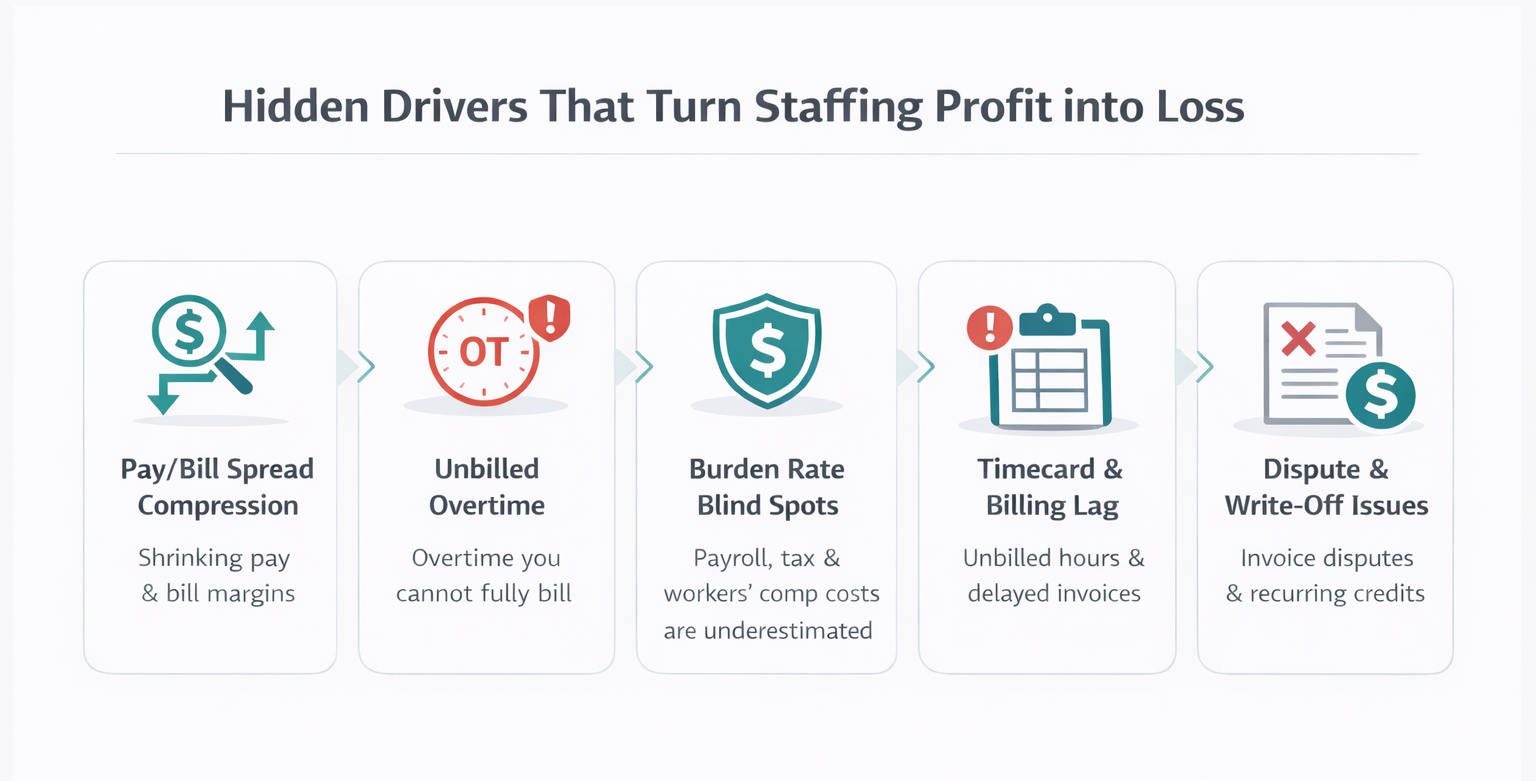
1) Pay/bill spread compression
This is the classic staffing margin problem: the spread shrinks a little, and no one notices until it’s too late.
Common causes:
pay rate increases without a matching bill rate increase
client pushes back on pricing
role mix shifts toward lower-margin positions
A small change matters. A $1/hour spread drop across 10 contractors working 40 hours a week is a real hit every month. If you are not watching spread trends by client, you are guessing.
2) Overtime that you cannot bill (or cannot bill fully)
Overtime can wipe out margin when:
the client caps billable OT
the bill rate does not adjust with OT
OT is approved after the fact and becomes disputed
The biggest red flag is simple: OT paid, OT not billed.
If that happens consistently, the client is not a margin problem. They are a terms problem.
3) Burden rate blind spots
Payroll taxes and workers’ comp are not optional. They are part of the cost to deliver staffing revenue.
Many firms apply a flat burden rate across all roles and clients. That makes reporting easier, but it can distort reality.
Roles with higher workers’ comp exposure or different state tax treatment can create a profitability gap that never shows up if you are using broad averages.
4) Timecard lag and billing lag
Client profitability is not just margin. It is also how cleanly and quickly you can bill.
Late timecards create:
unbilled hours
delayed invoices
increased disputes
slower cash collection
Even if the margin is fine, a client that delays timecards can create cash pressure and extra internal work every cycle.
5) Write-offs, credits, and “relationship discounts”
Most firms have a monthly write-off number. Almost none track it by client.
That is a mistake.
A client that regularly disputes invoices, requests credits, or expects “make-good” discounts can erase gross profit quietly.
If write-offs are concentrated in a few accounts, you have client-level problems, not a company-level problem.
6) The hidden cost nobody models: internal time
Some clients require constant attention:
onboarding churn
schedule changes
compliance and paperwork
escalations and firefighter work
A client can be “profitable” on paper but unscalable in real life. If the account manager and recruiter time is out of proportion, the account is costing you more than your financials show.
The staffing client profitability checklist
Use this as a monthly or quarterly review for your top accounts.
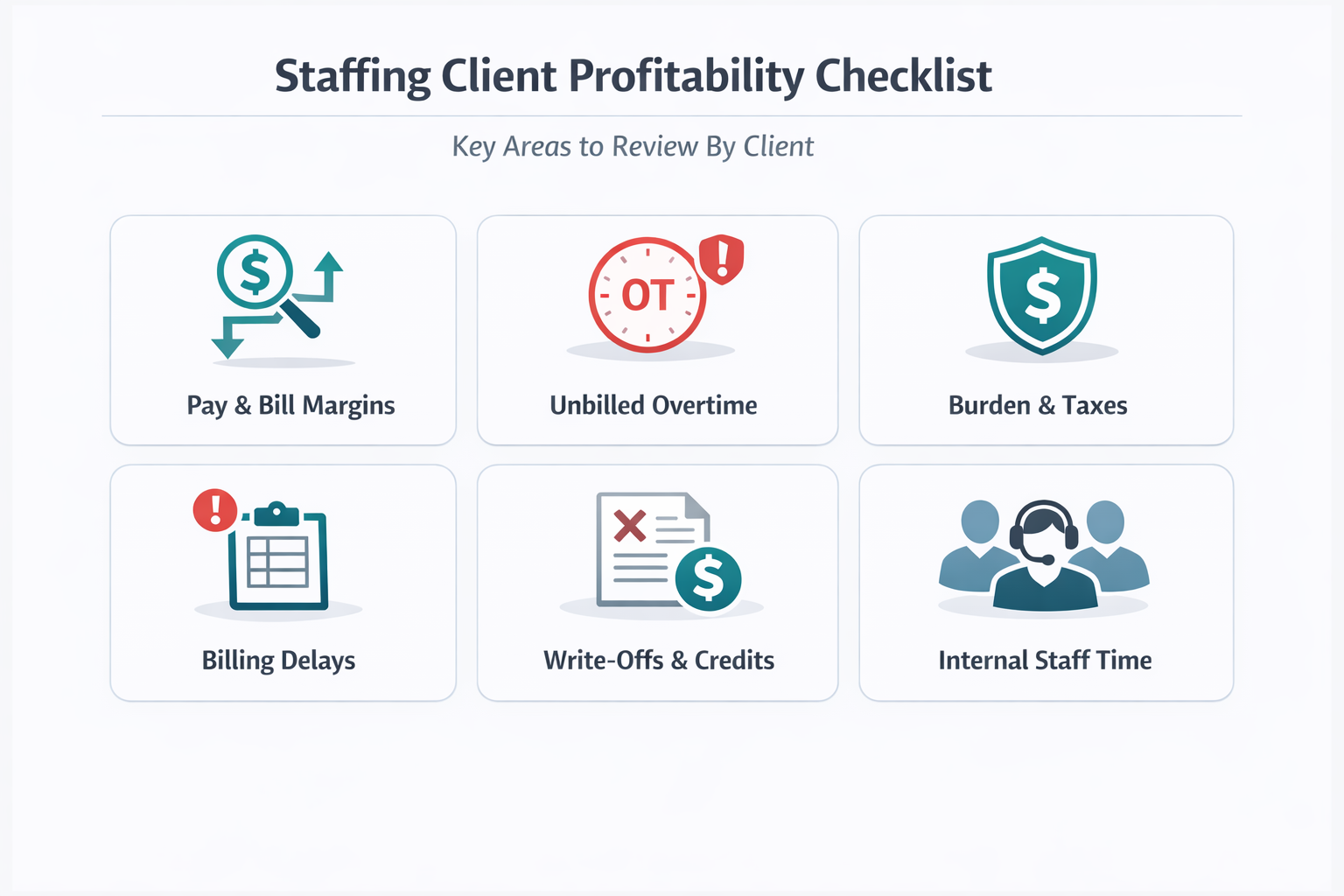
Margin and spread
Is pay/bill spread stable, improving, or shrinking?
Are pay rates rising faster than bill rates?
Are we hitting our minimum spread by role?
Overtime
How often does OT occur?
Are we billing OT correctly and consistently?
Do we have OT paid but not billed?
Burden and delivery cost
Are we using the right burden rate for this role/client/state?
Are workers’ comp and employer taxes treated correctly in reporting?
Are benefits or other delivery costs creeping up?
Billing and operations friction
Are timecards approved on time every cycle?
Are invoices sent on a consistent cadence?
Are there repeated billing exceptions or missing info?
Disputes and write-offs
How many credits or write-offs occurred this quarter?
Are disputes tied to the same root cause (rates, timecards, approvals)?
Are we absorbing “relationship discounts” as a pattern?
Cash behavior
What is this client’s payment timing relative to terms?
Is AR aging drifting older for this account?
Do we have a clear escalation process when they fall behind?
Internal cost and scalability
How much recruiter/account manager time does this client require?
Are we dealing with frequent churn or constant rework?
Does this account feel clean and repeatable, or chaotic and fragile?
Decision rules: fix, reset terms, or exit
The goal is not to fire clients quickly. The goal is to spot bad accounts early before they become anchors.
A simple approach:
Fix when the root cause is internal (billing process, burden modeling, timecard workflow)
Reset terms when the issue is client-driven (OT rules, approvals, pay/bill adjustments, deposits, credit limits)
Exit when the client repeatedly fails basic standards and refuses changes
This isn’t about confrontation. It’s about standards: terms, pricing, and follow-through.
Final Thought
A “profitable” client is not defined by revenue. It’s defined by clean spread, true delivery cost, and a working relationship that does not require constant exceptions.
If your top-line looks fine but the business feels heavier than it should, one or two clients are often the reason.
In our free Accounting Review, we look at the drivers that usually distort profitability, like gross margin structure, billing timing, and AR patterns. If client-level profitability is a concern, we’ll talk through where to start and what to measure first.